


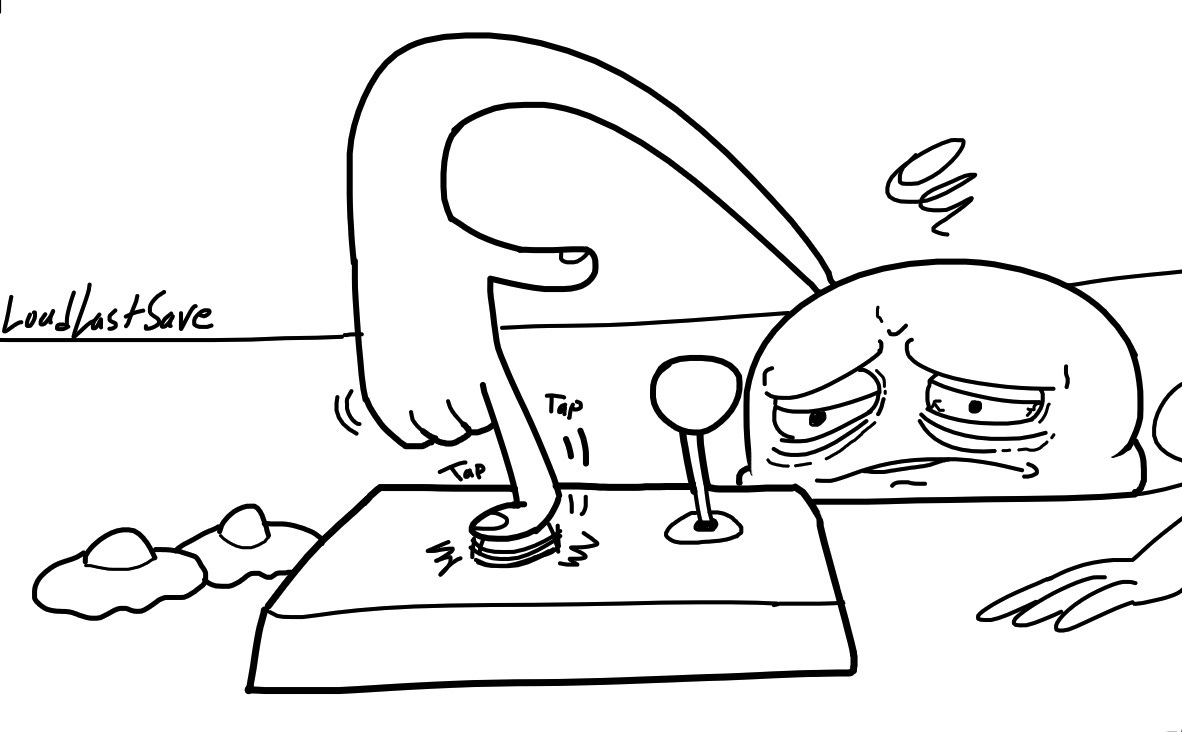
Riot’s long awaited fighting game finally went public, giving a select few a chance to get their grubby mitts on it. I was one of those, and I did indeed get my Dorito-encrusted fingies all over it. Is it the shining, golden champion that will introduce thousands of new players to fighting games? Are its mechanics an elegant blending of old school depth with new school convenience? Do the devs know what they’re doing? All this and more on today’s episode of “Asking too many questions in the opening paragraph!”
2XKO is the unfortunately named 2v2 tag fighter from Riot Games, makers of League of Legends, League of Legends on phones and League of Legends with cards. I say unfortunately named because come on, just look at that thing. Two Ecks Kay Oh. I’ve taken to calling it “Two Eggs”, which is apparently funny in Spanish.
The developers set out to create a fighting game that was hardcore while appealing to newbies. All the depth, fun and chaos of Marvel vs Capcom, with the ease of access and on boarding of a modern fighter. It features a slick, streamlined control scheme that lets you jump right into the fights like you know what you’re doing. You’ll be pulling off big, multi-hit combos that you can post on twitter and pretend like you know how to play.
Controls
The control scheme is a commonly used three-button set up: Light, Medium and Heavy attacks. The other two buttons are for special moves, S1 and S2. Then there’s the tag button. A full six-button configuration.
The reason why some games opt for a Light, Medium, Heavy layout instead of one with three punches and three kicks is for simplicity. They need the other buttons for other functions, like tags. Marvel vs Capcom 2 used 4 buttons for attacks and 2 for assists, same with Marvel vs Capcom 3.
Two Eggs, being a more simple fighter, decided to go with a… 5 button scheme. Three attack buttons and two for specials. Feels strange on a pad, but it’s something you can get used to, or reconfigure, if you can find where to put them all. Then there’s the tag and dash button, because dashing by tapping the directions is an antiquated idea, apparently.
The reason why there are two dedicated special buttons is because motion inputs are bad, mmmkay. Nothing prevents someone from enjoying a fighting game quite like having to move the stick to do a special. It’s an insurmountable barrier; a 60-foot-high wall of pure inaccessibility standing between little Timmy and his sick twitter clips. Such a tragedy mustn’t be allowed to happen in 2024, so we use buttons for our specials now.
This reliance on having one special (and one directional special) per button means that each character has a very short, stubby move list. Now, a short move list can be a good thing. A robust, pared-down toolkit where anything unnecessary is cut out. Survival of the fittest. Guilty Gear Strive did a good job of this. It removed a lot of the character’s moves, but it kept a few important tools that represented the character and differentiated them. In 2Eggs, the few special moves you get per character are underwhelming. Darius has a giant axe swing. In the air, he has another axe swing. Yasuo, on the other hand, gets bloated stances and rekkas with more forking paths than a fractal river. Each ending scattered throughout all the buttons, some on special some on regular attacks, because they don’t have enough buttons and are trying to solve a problem that could have been solved with a few swoops of the joystick.
Gameplay
Enough about the inputs, what about the game? Well, you can’t discuss the game without discussing the inputs, in this case the auto combos. Every button, Light, Medium and Heavy, has an auto combo. You can manually press the sequence, but unless you have some complicated tech you found, it’s best to stick with the autos. They let you confirm anything into a full, damaging combo with no effort. Most of my matches devolved into me mashing a button and getting huge damage off stray hits.
I hate auto combos. You can have long combos like in Blazblue or Marvel Vs Capcom, but at least make it take some skill. If someone gets me in a 40 second combo, I want to know that the person on the other end spent hours nailing that down and earned it. Now they can press light over and over and get a full combo into an advantageous knockdown.
It feels very mashy. Sure, you need to navigate neutral in order to land a hit, but once you do, just roll your face on your preferred input device and you’re doing it right. Clip someone with an errant light attack and keep pressing it until the opponent is down, then press it again because hey, it automatically chains into a special that’s safe on block.
There are tools to mitigate this, to try and bring the chaos down to a manageable level. There’s push block, which costs an entire bar of super meter. It pushes your opponent away. There’s a parry with an incredibly generous window, which auto-rejects an attack and lets you counterattack. This also costs one bar, but it’s refunded if it hits. There’s a burst, which is a way of saying “Yeah our combos are insane so we gave you a function that just stops everything”. I know you can bait bursts and play around them, but that’s what they are, and wake up attacks. A lot has been done to make sure there are tools on defense to stop the onslaught of auto combos and assists.
This all leads to a game that wants to be hardcore and complex, but it doesn’t play like one. It tries to streamline the learning process; to get as many people in the door as possible with its promises of flashy combos and instant gratification. Little Timmy can’t spend a few minutes learning to do motion inputs. He wants his twitter clips now! He’ll clench his fists and kick his toys if he’s not doing a 20-hit combo within the first three minutes of playing. He wants to get to the real, high-level play. Sure he doesn’t know what oki means and can’t navigate neutral without jumping, but he needs the reads, the YOOOOO moments, all by pressing buttons, and the game obliges.
I didn’t have to consider any options or have situational awareness to capitalize on stray hits. I just played neutral and threw out medium hits that lead into damaging auto-combos and easy oki. I could score a knockdown from anything, anywhere, all the time. I didn’t have to consider much other than the burst bars, to make sure I could keep my combo going without getting thrown back. Even then, all the burst does is return the situation to neutral, when I could go back to applying pressure.
It’s an Alpha, shut up
“Try doing that against the best players”, you might say. Sure, it won’t work. Doesn’t have to. It works on every other shmuck. That’s good enough for me.
“The game isn’t even out yet, no one knows how to play, this isn’t an accurate representation of it.” Great, I didn’t know alpha meant that I couldn’t form opinions on it. I played Street Fighter 6’s beta. I was there day one when no one knew how to use the drive rush. People would throw out random Drive Impacts and slime rush out of a heavy punch into a jab jab jab dropped combo. I didn’t know how to use the system properly, either, but I wanted to. I saw that it had potential. It had something to offer, even if a lot of people think it’s anathema to Street Fighter’s design philosophy. I was stumbling along wasting all my drive gauge in the first few seconds of a round, but I could easily see that, in the hands of an experienced player, this was going to be interesting.
Heck it was even interesting for me when I still couldn’t get the hang of it. Why did I go on that tangent? Because I didn’t get that same sense with 2Eggs. After coming to grips with how the game felt (incredibly subjective but I didn’t like how it felt), and using some of the systems, all I came away with was “Oh. This is it.”
This is the same thing I was harping on about in the input rant. This push for instant gratification, constant offense flashy combo gameplay. Those dang swirly quarter circles are what’s keeping me from unleashing my true FGC God potential and laying waste to scrubs. Now that every tool is available from the push of a button, I can frustrate newbies with high level tech instantly, with one button.
This isn’t just me being a crusty old man demanding that the lazy youth of today earn their sauce. It’s me saying that this isn’t the way to get new people into fighting games. The game itself does a horrible job of teaching anything. The tutorial is awful. It’s that kind of lazy “Do this thing three times” tutorial. It takes great pains to make sure you know how to move and block, but it doesn’t even tell you that you can push block. None of the “advanced” mechanics are explained or even hinted at. Sure, they tell you how to burst, but it doesn’t even tell you that the burst is tied to a bar. At first I thought it was meter-based, or a once-per-round deal but no, the bar below the health, the one understated little bar that could be a guard meter, is the burst bar.
To find out anything about any other mechanic, you have to look at the movelist, which has a section for universal moves. There you can see that you can perform a push block and a short explanation, but no real way of knowing why you would want to do that. If you have played Marvel vs Capcom before, you’d know why push block exists, but for anyone else it’s a waste of meter that could have been used to do damage.
Fuses
The game also has a gem/-ism system called Fuses, where you pick different assist buffs. Again, not explained properly. I had to look these up online. The autocombos I whined about so much come from the Pulse fuse, and I didn’t even know while playing. Thing is, why should I use anything other than that? I was doing the big-boy combos with it and winning handily just by mashing a few buttons. I repeat myself: It converts anything into a full, damaging combo into a knockdown. Without me having to think. I could be browsing twitter, looking for more sick sauce clips, and still play like I know what I’m doing (Hint: I don’t know what I’m doing). Sure maybe the Fuse system has some depth to it, and some are better for some teams.
There’s one that gives you extra power when you get below half health, another lets you use two tags in a combo and so on. They are interesting and could offer some depth, but they don’t let you do auto combos.
What this game reminded me of was DNF Duel. Massive, disjointed hitboxes, long pressure strings, easy inputs, high damage. When I say massive hitboxes, I mean attacks that are a few pixels away from being full screen.
BUT IT’S AN ALPHA
Yeah, it is. It’s pretty polished for an alpha, but there are some issues that have to be addressed now. The horrid tutorial being one of them. This game has been in development for EIGHT YEARS. Sure, it has changed identity more times than a teenager discovering politics on YouTube, but from the beginning it was designed as “babby’s first fighting game”. It’s based off Rising Thunder, a 1v1 fighter that was intended to be just that. It had a simplified control scheme and it was about offering a streamlined experience for newer players. A toned-down, neutral-focused fighter. Riot bought them and twiddled their thumbs for a few years and came out with Project L, the first iteration, which featured Jinx and was a 1v1 fighter. Something closer to Rising Thunder, something that would be a lot more friendly towards new players.
Then they turned that into a chaotic 2v2 fighter with systems piled on like they’re making a seven-layered dip of rules, coupled with a simplified controls scheme where every button is stretched thin pulling double or even triple duty trying to fit all the functions the developers could cram in without resorting to motions. They released the alpha with a horrific tutorial that doesn’t explain anything. I am not new to fighting games and I had a hard time figuring out where things were and how they worked.
I’m not going to make much of a fuss about the number of characters. They might have a ton of characters hidden in the back waiting for their turn, but I don’t think they’ll release the full game with a roster of more than 10. In a tag fighter, having a large roster is a necessity. It’s not like every one of these fighters has a 50 page move list like a Tekken character, so they could make more, but after five years all they have to show is the original roster (minus Jinx) and Illaoi.
What I will say about the characters is that they don’t have much of an identity. Sure, Echo has his annoying projectile and time loop combos, and Yasuo has his stances, but it all amounts to nothing. Ahri has an air dash, so you air dash in and mash, instead of ground-dashing in to mash like with the other characters. Their kits are boring, too. Ahri has a projectile and then a big attack as her specials. Darius has a pull and a big attack. In the air, he can also do the grab and the big attack. Illaoi leaves tentacles that die in one hit, and she also has a big attack. It’s all a blur of massive, swooshing hitboxes with no real rhyme or reason.
My overall impression was one of a chaotic game that tries to play itself. I didn’t like how it felt. The avoidance of motion inputs makes every button into a specialized thing that doesn’t do much else, so all the other functions have to be mapped onto combinations and macros. There are a ton of massive, safe attacks and since there’s no hitbox viewer I can’t confidently say that they’re disjointed, but they probably are because I didn’t see any real whiff punishes. Speaking of punishes, there are status pop-ups that inform you if a hit was a punish and such, but they’re so small and out of the way that I only started noticing them after a few hours. In the middle of a match, they convey no meaningful information.
I won’t talk about the balancing much, either. This is Riot, after all, a developer whose game designers work in separate offices and don’t communicate. I was an avid League of Legends player from 2010 to 2014 and the constant, baffling balancing and design decisions in that game were vomit-inducing. Champions with 500-word ability descriptions and abilities full of “And”. An ability that provides mobility AND deals damage AND slows AND stuns AND adds a stack of a passive on an enemy which deals bonus damage AND removes stains AND prevents wrinkles. It’s maddening.
Same thing with Legends of Runeterra, which I was hopelessly addicted to for about a year. Then they released Kaisa, a card whose gimmick was “gets every buff everywhere all the time” so you end up with a Champion card that’s stealthed AND shielded AND can deal direct damage AND has magic immunity.
Any comment on the game’s balance is going to be outdated in a few days. With how nerf-happy they are, one day something might be incredibly powerful and the next it’s completely useless. Maybe they rework your favorite character and change their entire kit. Anything is possible in the wild and wacky world of Riot balancing.
Conclusion
This is a beginner friendly game that tries to be hardcore. It gives everyone a huge bat assuming it will even the playing field, but that just leads to the big kids bullying the smaller ones even harder. Sure they’re one button press away from breaking from my pressure, but I’m one button press away from a full sequence into an advantageous knockdown and look at that here comes my partner with an assist that I don’t even have to time. How great. Now hold this L. This Project L.
Now that I don’t have to deal with this anymore, I can get rid of it and the accompanying Vanguard spyware. Oh, I didn’t mention, but the game has kernel-level anti-cheat. I know most people don’t care about that, since there are three trillion players slurping up League of Legends and Valorant, but it’s there. It sticks into your computer and runs even when you think it’s off. Bit of a dealbreaker for me. I endured it for the playtest, but I have since purged it from my home.
To uninstall Vanguard you should turn off my computer, make sure it powers down, drop it in a 43 foot hole in the ground, bury it completely, rocks and boulders should be fine, burn all the clothes I may have worn any time you were alive. Pretty simple.