


Let’s go gambling!
The cards are hot, the jokers are wild and the tables are calling. Time to play some poker, and since I’m doing it from the comfort of my own home, I don’t have to wear pants. Today we’re talking Balatro, a game you’ve already heard of. It combines the tried-and-true simple fun of poker with some clever deckbuilding elements to give a new twist on an idea. It’s one of those things that makes you go “why didn’t I think of that?”. Like stuffing a pair of twos in your pocket. No one would suspect you cheating with such a crappy hand, but that’s the genius of it. Balatro is a lot like that, but actually good, so it’s nothing like that.
Gameplay
Balatro is a poker roguelike deck builder. You make a deck using the standard 52 cards you already know: hearts, kings, aces, etc. You have to get to a certain point threshold at to beat a “stage”. Each ante, or level, is made up of three blinds/stages. In these you form poker hands to gain points. For example, a pair for a small prize all the way up to a straight flush which gives you a ton of points. After each stage you can go to the shop to buy more cards to stack your deck.
The core gameplay is very simple. You make poker hands. Got two eights? Make a pair, get 50 points. If it were only that, the game would get old quickly. There’s only so many times you can make a double pair before you turn the game off and go do laundry, but that’s where the Jokers come in.
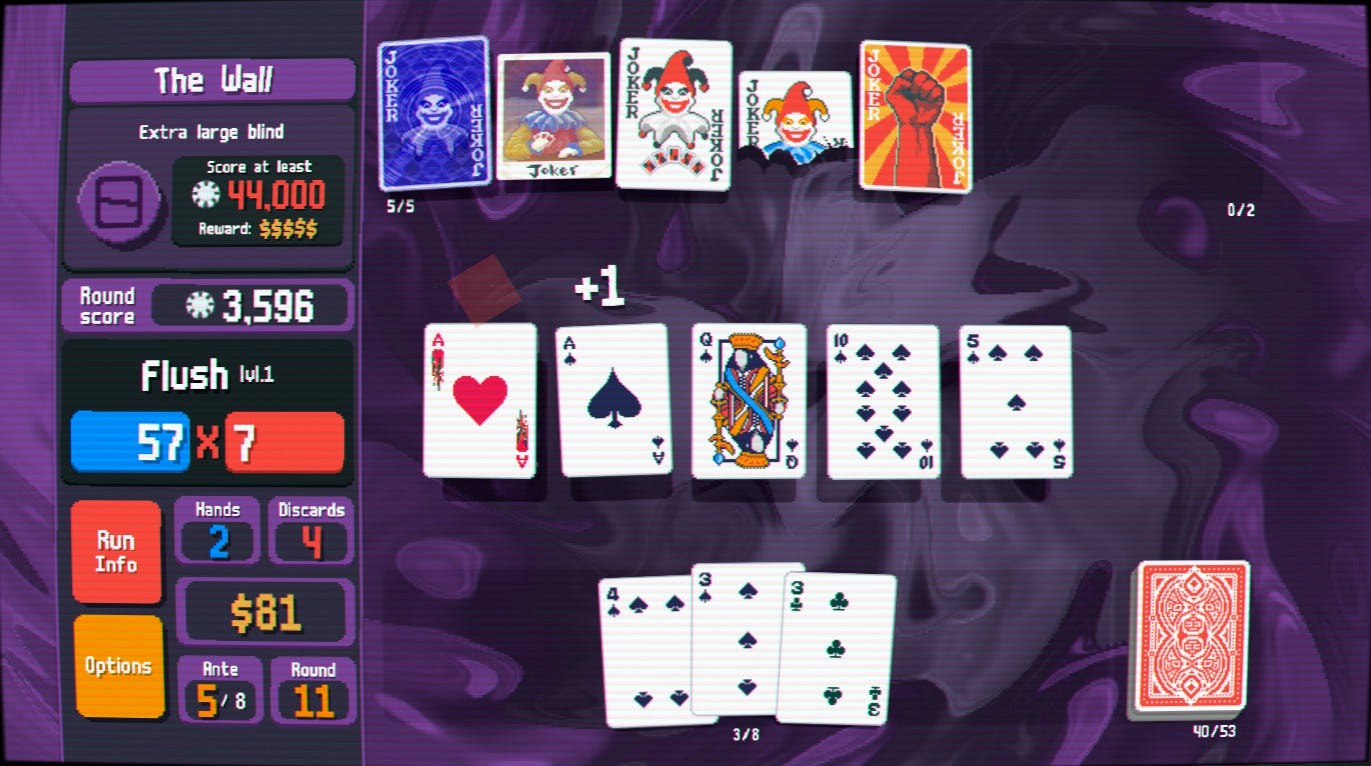
Jokers are special modifier cards that greatly alter the scoring. They range from simple, such as “add more chips to spade cards” or “add 100 chips if you play a straight”, to more complicated things like “add one to the multiplier for every scoring hand without a face card”.
Along with the Jokers, there are also consumable tarot and spectral cards. Tarot cards provide one of many benefits when used. They can turn two of your cards into bonus cards, which makes them worth more points when scored, they can raise their value, remove them from your deck or give you money. You can hold up to two at a time, and can be used in the middle of a round for immediate effects. Spectral cards have similar benefits, but they have some downside to offset their value. One can add four random enhanced cards into your deck, but it destroys a random card. Spectral cards can’t be kept like tarot cards and must be used when discovered.
There are also planet cards, which improve your hands. Your hands as in the poker hands you play. They don’t give you a manicure. As mentioned before, each poker hand has a base score and multiplier associated with it. The Two Pair, for example, gives 20 base chips with a multiplier of 2. If you use a planet card for the Two Pair, it will upgrade it to 40 base chips and a multiplier of 3. There is a planet card for each possible hand (including some for impossible hands. More on that later).
These cards, and other goodies, can be bought at the shop. After each round you go to the store, where you can spend your hard-earned money. There are booster packs, one for each kind of card, which you open and select from a random group of cards. There are vouchers, which are buffs that last through the whole run. Things like adding an extra card to each hand, adding an additional hand to each round or increasing the money you get from interest. You can also buy individual cards, if they show up.
That all sounds a little complicated, but it all fits together in a surprisingly elegant way.
Scoring
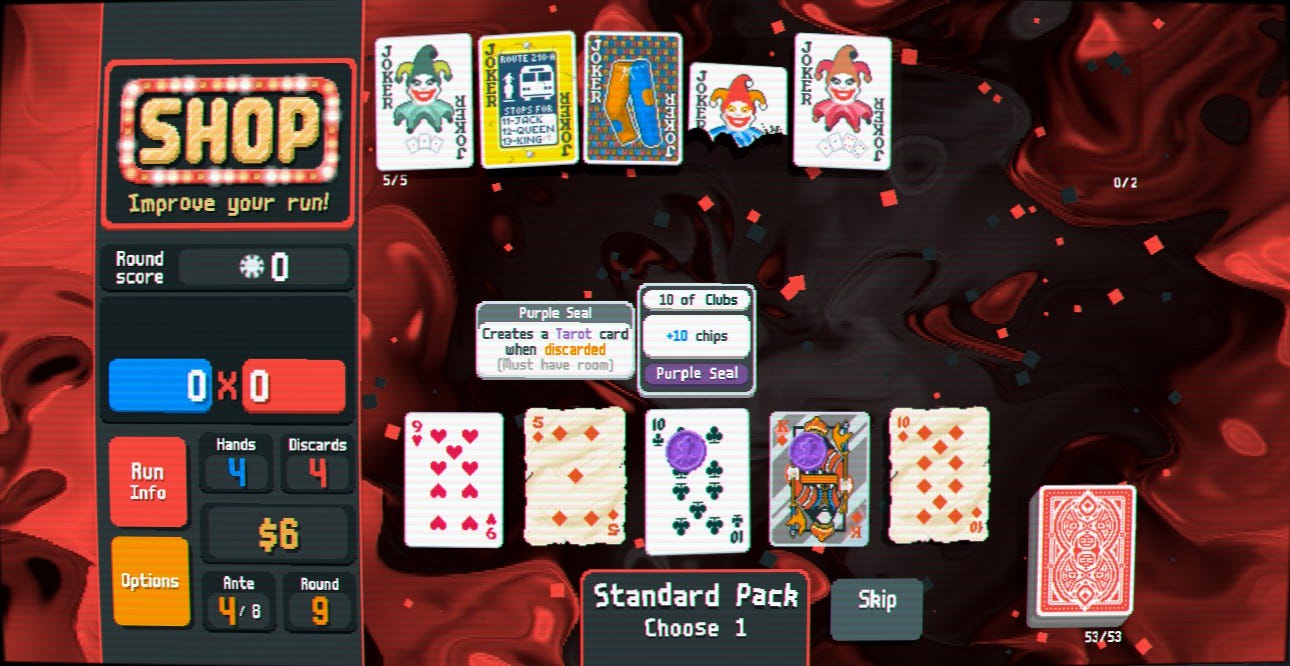
The most important thing to learn about Balatro is its scoring system. All your efforts in this game go towards the singular goal of getting massive numbers. Every decision can be boiled down to “How can I make this give me the most points?”; which jokers to buy, what cards to pick and even what hands you’ll play.
The system itself is intuitive, simple and has a few variables to manipulate. It’s like the one in Tony Hawk’s Pro Skater: You have a base amount of points that gets added and a multiplier which, as the name suggests, multiplies the base. The resulting number is your score. Card combinations give a base score, while the cards’ value is added on top. Each hand has a set value and multiplier, with more difficult hands having a higher payout. A pair, for example, gives 10 points and a multiplier of 2. If you play a pair of 5s, you get 10 points for the hand, plus 5 for each five played, then it all gets multiplied by 2, for a total of 40 points. It’s a little wordy if explained in text, but all you need to know is number on the left gets multiplied by the number on the right, and there are a lot of ways to make each of them bigger.
I really like this system. There are a lot of ways you can play around with these two values. Increasing the base by adding to it, adding to the multiplier and also multiplying it again for even bigger gains. It’s an elegant system that introduces a lot of decision making when building your deck. You need to balance getting a lot of base chips, but getting multipliers is great, but what good are multipliers if you have nothing to multiply? Trying to get the optimal balance becomes an engaging puzzle that stays fun for hours.
Jokers
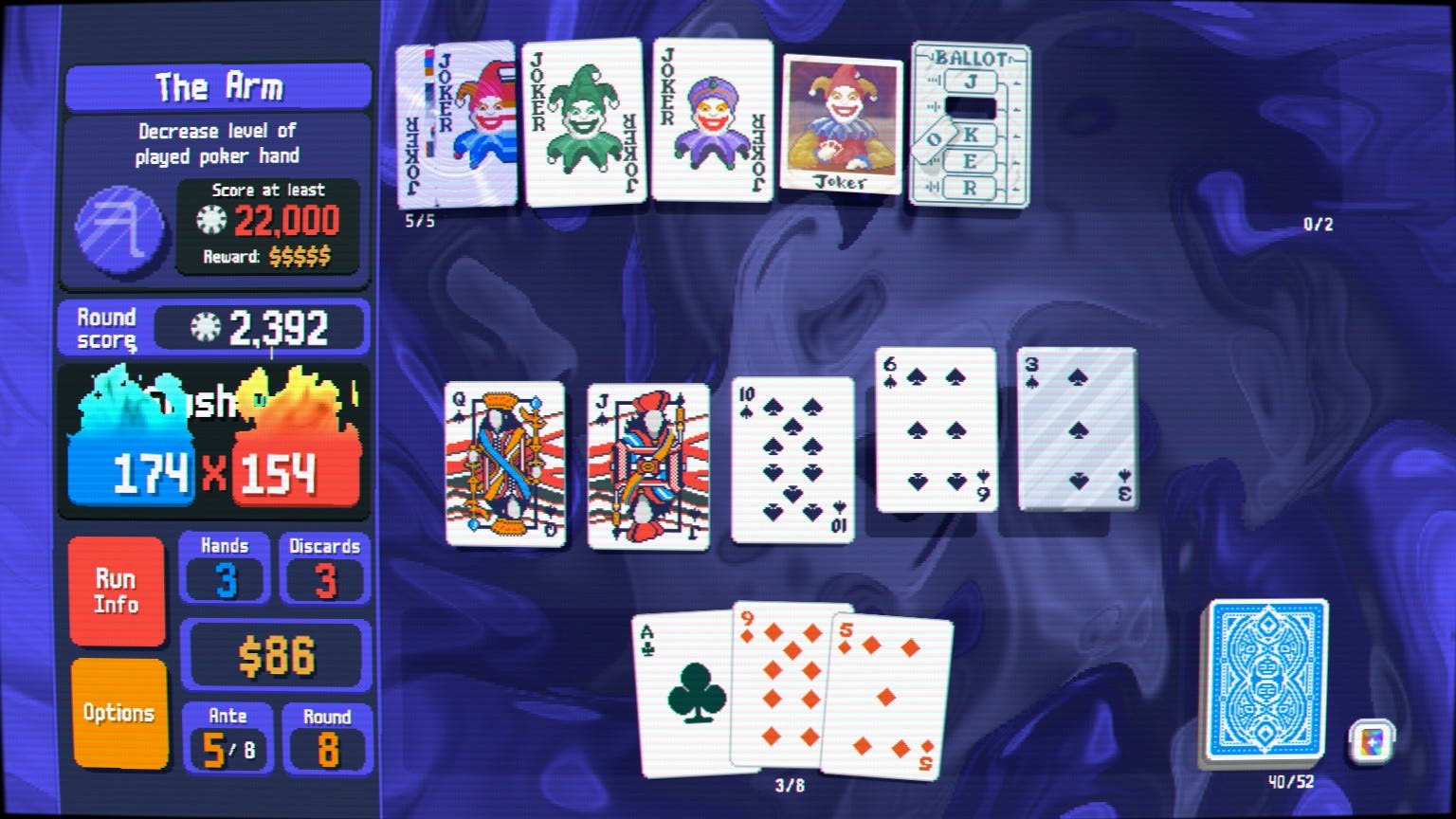
Jokers are the guys you go to if you want big numbers. They’re special cards that provide passive buffs, comparable to Slay the Spire’s relic. They sit in their own inventory, and affect scoring and other rules. These are what decide what you’re going to do. They range from simple effects like adding a set number of points to specific hands, to more esoteric things like gaining a multiplier when you open a booster pack but choose not to get any cards. They can be bought at the shop either individually, in booster packs or even created from thin air using other jokers.
They’re divided into four different rarities: Common, Uncommon, Rare and Legendary. Common jokers usually give small rewards, but are cheap and easy to find. Uncommon have more interesting rules, but are a little more expensive. Rare Jokers are very hard to find, and they provide strange, conditional benefits, and Legendary jokers are ones you very rarely encounter and have massive bonuses.
There are a ton of jokers in most rarities, with Legendary only having 5, and they all have their use. Some are general-purpose and considered “good”, while others are a bit more niche and work better with specific decks. I’ve found that they’re mostly good and well balanced. There have been jokers, such as “Ride the Bus”, which I’ve found useful but annoying to use, that become incredibly useful with certain decks. Ride the Bus gains +1 multiplier for every hand played without a face card (jack, king and queen) and the abandoned deck does not have face cards. The synergy is obvious, but unlocking the deck, then seeing the joker and putting 2 and 2 together in my head was the kind of satisfying moment I look for in card games.
Jokers are scored from left to right. They sit in their little bench at the top of the screen and whenever you complete a hand, the game goes from left to right activating each. There are some that activate first, no matter their placement, but this is how it generally works. This means that knowing how to place jokers is important. A good rule of thumb is to set them in order from points, to +multipliers to multipliers. That way, you add the points, then add the multipliers, them multiply the whole thing. Some jokers, such as The Blueprint, act different depending on where they’re placed. This small detail gives the game a bit more strategy. There’s even a boss that shuffles your jokers, so if you have a meticulously crafted engine, you’re screwed.
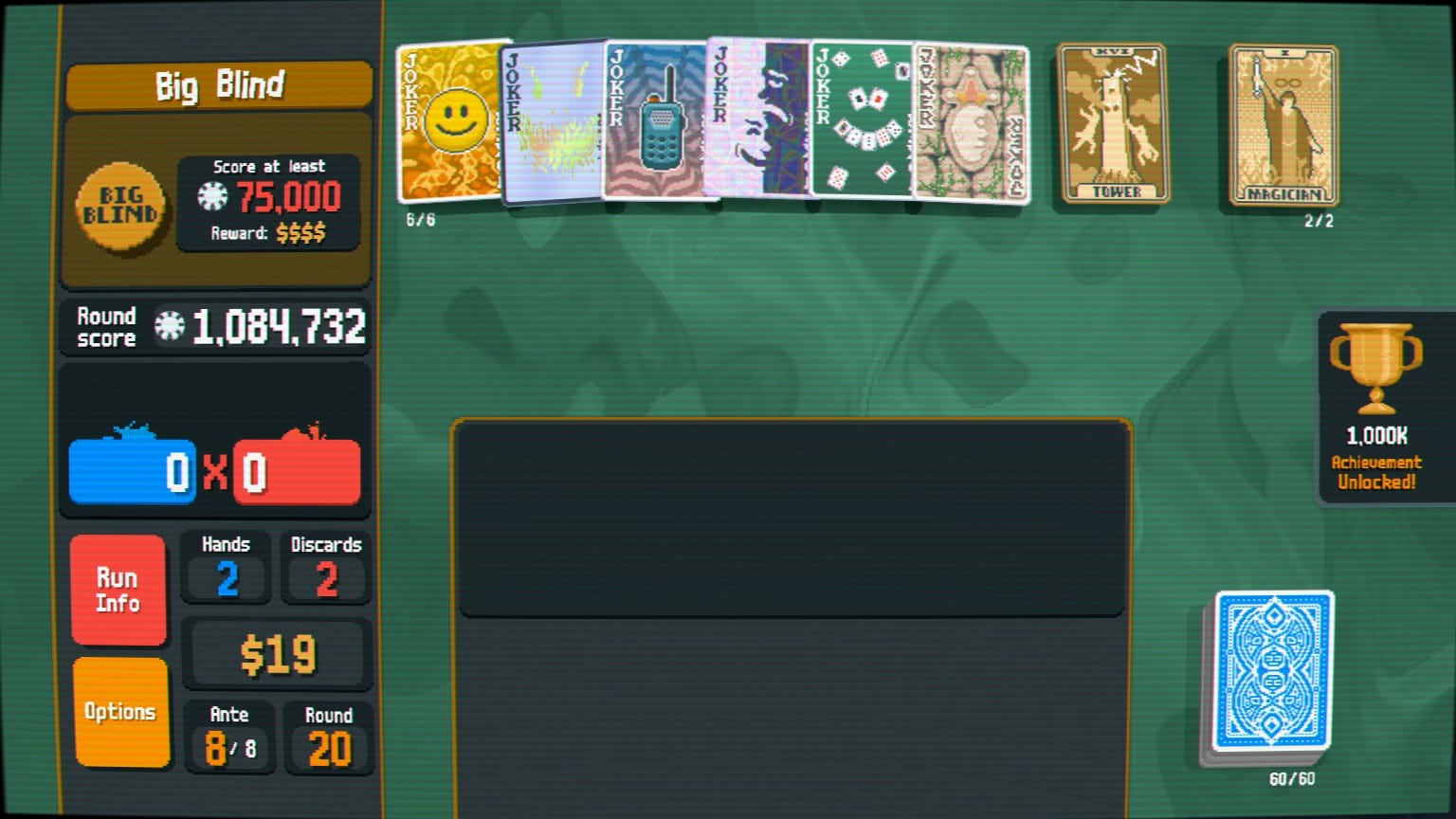
They’re all useful in their own way, but I have a few that I’ll always gravitate to when I see them. The Hanging Chad is one of them. It re-triggers the first card played in scoring. This one requires a bit more active play, since the first card the game picks to score isn’t always the one you want, so you need to be mindful and manually place the card you want at the start of the scoring order. This one leads to some obvious synergies, triggering special cards multiple times, racking up huge scores. I once had a run where I got this, Photograph and Scary Face, and I was making a killing off stray face cards.
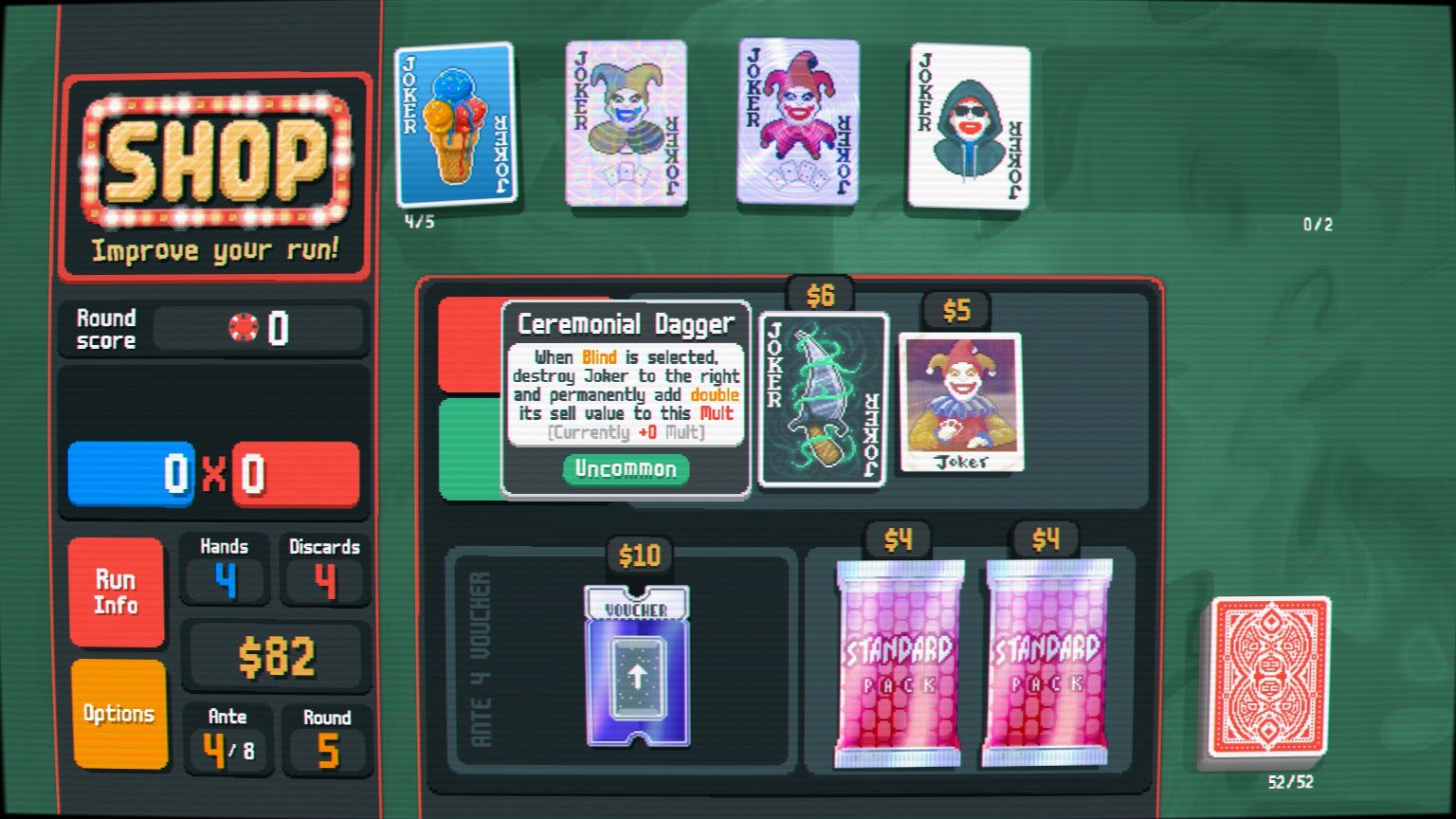
My two personal favorite jokers are Madness and Ceremonial dagger. I love scaling points, and I love risk/reward, and these two bring that in dangerous amounts. Madness destroys a random joker at the start of each non-boss round, and Ceremonial Dagger destroys the joker to its right. They scale, meaning they can keep adding to themselves infinitely. I’ve had more than a few runs go down the drain because I can’t control myself and end up grabbing Madness or Dagger. There’s something about that high-stakes living on the edge energy that calls to me, even if it means sacrificing a boring but useful joker to the dagger just because I thought the multiplier would help me more. I had one run where I ended up with just the dagger with a +90 multiplier, every other joker sacrificed to the voices in my head that kept telling me “dude it’ll be so cool keep that multiplier going!”. I didn’t win, but I had a ton of fun. I just wanted to see how far I could go. Another I really like is Erosion, which gives bonus multiplier if you have less than 52 cards in your deck. Again with the theme of wanton destruction in pursuit of momentary gain. It’s almost like it’s an allegory for gambling, but gambling is only destructive if you drink while doing it, and casinos serve alcohol. Then they expect you not to act disorderly at the tables.
Deck Building
The deck building elements in Balatro are on the lighter side. There are a lot of fun rules and interactions to discover, but there isn’t much in the way of deck manipulation. It’s more about planning a strategy around what’s given to you. That might sound like a regular deck builder, but there are very few ways to directly alter your deck here. You start with a standard 52 card deck (for most decks, there are some exceptions), and there aren’t many ways to destroy cards or control how you interact with it. There are ways to alter how many cards are in your hand by modifying the hand size, but there aren’t any draw cards or things like that.
You can use the Tarot cards to transform cards into others, change their suit or alter their value. There’s also the Hanged Man, which lets you destroy up to two cards, but there isn’t a reliable way to remove cards from your deck.
Is that a bad thing? No. The game is balanced around its more streamlined deck building. The lack of draw cards is due to the discard system, which limits how many times you can re-roll cards. Weighing the risk and reward of each discard is a fundamental part of the experience. Draw cards would interfere with that mechanic.
Why do I bring it up, then? Since it’s a deckbuilder, I have to mention the fact that it’s a bit light on that end. There aren’t crazy chains, exhausts or weird tricks you can do where you keep drawing cards in a loop. It’s more restrained in that aspect, but it still manages to be interesting, just don’t expect any Slay The Spire or Magic The Gathering type shenanigans where you meticulously craft a 15-step combo. It’s more about maximizing the effects of your Jokers than anything, so if you’re looking for esoteric loops that take 6 minutes to play out, look elsewhere.
Bosses
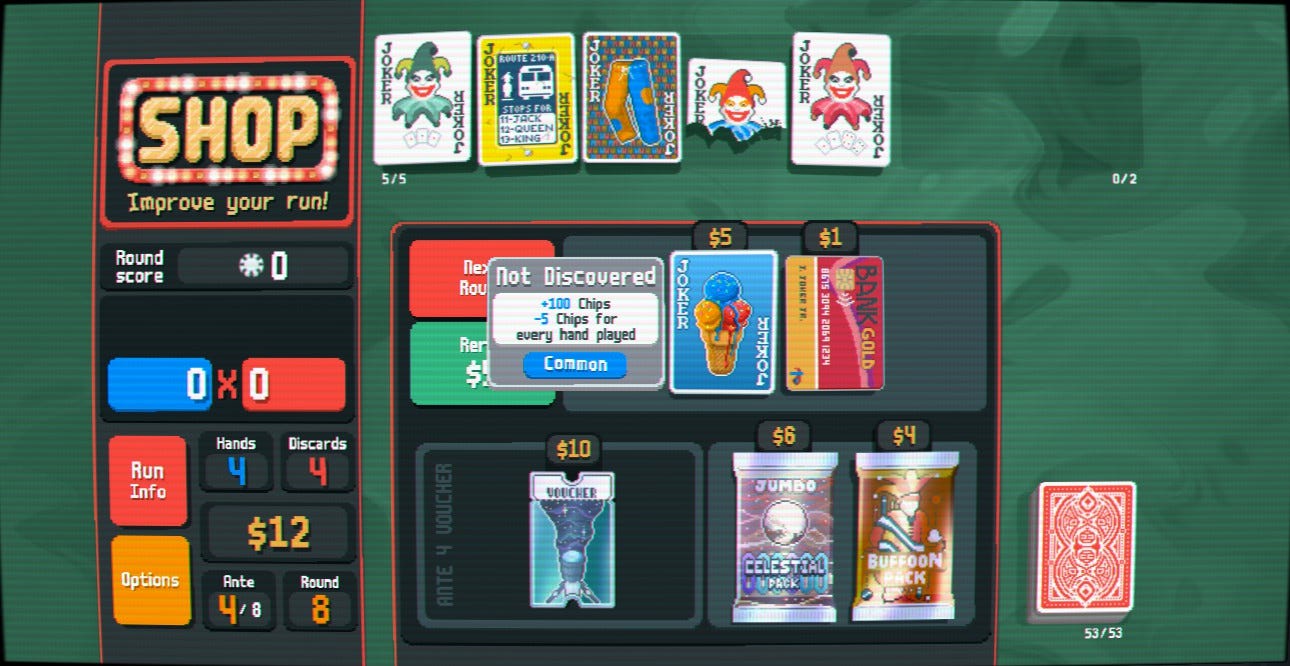
At the end of each ante (round), you fight a boss. These have a higher score requirement and they apply a condition, making things a lot harder for you. Some are simple, some are annoying, and some are designed to tank your run. I’ll go over them and give a few quick thoughts on each.
The Hook: Discards 2 random cards in hand. Difficulty: Negligible. Whenever you play a hand, it grabs two of your remaining cards and gets rid of them. This can screw up any strategies you have lined up, but I fly by the seat of my pants, so it doesn’t affect me much.
The Ox: Playing your most played hand this run sets money to $0. Difficulty: Beyond trivial. Laughable. I used to think this set your money to zero if you played a two pair, because it’s what I play the most. Two pair for life. I don’t care if this thing takes all my money for it, I’ll still play two pair. How do you think I got that money in the first place? You tell me not to do it, and I will look you in the eye and give you two pairs: two cards, and my wallet and credit cards. Take them. I don’t need them. I got another two pair lined up. Those spare trousers are up to 50 multiplier, buddy.
The House: First hand is drawn face down. Difficulty: Trivial.
The house always wins? Not with this weak game. Sure, it costs a discard, but it’s manageable. Or you can play a blind hand, if you really are about that gambling life.
The Wall: Extra large blind. Difficulty: Depends.
If you get this in the first few antes, it’s manageable. Later on in the game, the score requirement can get pretty high, but you have a build going and can surmount it. In the mid game, however, when you’re in the awkward teenage years of your build, where you think vaping makes you seem cool and you have two contradictory common jokers and a non-synergized uncommon, you get smoked. It’s like trying to make a political statement when you’re sixteen.
The Wheel: 1 in 7 cards get drawn face down during the round. Difficulty: Annoying.
It’s not bad enough to be a run ender, but it can be bothersome. I like to play the face down cards anyways. Gambling. If you apply a tarot card to a face down card, you can see it. Doing those kinds of little cheats was what got me thrown out of Vegas once.
The Arm: Decrease the level of played poker hand by 1. Difficulty: Why would you do that, man?
A little annoying, but it can be done, unless you come in with a level 12 two pair and the intention to play that and nothing else. Like I’ve done. Multiple times. Like I said, you tell me not to play a two pair and I will show you two pairs. One being the cards, the other being the pair in my pants. That’s right, the pair of twos I put in my pocket. I know that’s cheating, I’ll be seeing myself out.
The Club, The Goad, The Window, The Head: These are all grouped into one because they disable one suit, making you unable to score cards of that suit. Difficulty: Potentially lethal.
If you specialize in one suit, and get the boss that blocks it, you’re screwed. If not, then it’s not that bad.
The Fish: Cards drawn face down after each hand played. Difficulty: Very annoying.
If you play small hands, like pairs and two pairs, you can get through without wasting all your discards. If you play a flush that you’re 100% sure will win, but leaves you with 10 points to go, then you have to deal with 5 face down cards. Not that I would know anything about that.
The Psychic: Must play 5 cards. Difficulty: I am an old man.
Not all 5 cards have to score, but you need to play 5 cards. If not, it does not count. For someone who is forgetful and keeps playing 2 pair without an extra card, I keep wasting hands that don’t get scored. I have lost an embarrassing number of runs due to the fact that I am too distracted to realize I played less than five cards. If you can do that, it’s an easy boss. If you’re like me, make an effort to remember the condition. The boss’s condition. Not the memory thing. What was I talking about?
The Manacle: -1 hand size. Difficulty: Is this thing on?
You have one less card to work with per hand. Wow.
The Water: Start with 0 discards. Difficulty: Trivial.
It’s bad if you have a deck with less hands than normal, or if you were specializing in discards. Usually not bad.
The Eye: No repeat hand types this round. Difficulty: Medium.
Keep things varied and save a pair or two for the last hands. Don’t want to get caught with zero discards trying to make a straight or a flush.
The Mouth: Only one hand type can be played this round. Difficulty: Lethal.
This thing is horrendous. You either play it safe and go for pairs and end up way below the limit, or go for a riskier hand and end up with no cards to play. The fact that it locks you out of everything other than the hand you first play is diabolical. A real run killer.
The Plant: All face cards are debuffed. Difficulty: Targeted.
This one comes up very rarely, but when it does, I have a face card-focused deck. It’s like a heat seeking missile. It’s possible to beat it with just number cards, but it’s tough. Especially considering how many easy synergies you can form with common face card jokers.
The Serpent: After play or discard, always draw 3 cards. Difficulty: Trivial.
Instead of refilling your hand after playing, you get 3 cards, so if you play 5 cards, you only get 3 back. It’s bad, but if you discard one or two you get 3 back. It’s a balancing act of draws and discards, but nothing too taxing.
The Pillar: Cards played previously this ante are debuffed. Difficulty: I am an old man.
This wins the prize for “most ignored condition”. I have gone straight into blinds without noticing this boss and have paid for it. Not severely, mind you. It’s just a minor inconvenience. It sort of forces you to skip everything before it, which might be bad, but it’s manageable.
The Needle: Play only 1 hand. Difficulty: AAAAAAAAAAAAAAAAAAAAAAAGHHHH
This is the run killer. Even if you think you can get enough with one hand, you won’t. You’ll get bad cards, you’ll score too little, it’s a mess. This is the most devious boss, and whenever I see it I mentally end the run before I even get to it. I have survived it with some cheesy builds, but most of the time it catches me off guard and kicks me out of the casino.
The Flint: Base chips and mult for played hands are halved for the round. Difficulty: Very High.
It’s halved, so if you had high-level hands, this will slash them down to 50% and give you scraps. I’ve seen powerhouse decks reduced to ash with this thing. The fact that it’s a percentage makes it worse, since it just completely kneecaps anything you might have going before it gets off the ground.
The Mark: All face cards are drawn face down. Difficulty: Tough.
I can’t see my face cards, but I know they’re there. With some deduction and luck, it’s manageable, but it’s still something that has to be considered. Not a pushover.
Final bosses:
Amber Acorn: Flips and shuffles all Joker cards. Difficulty: Easy.
It makes it so you can’t see your joker, and it scrambles them so they don’t flow like you mean them to. Not that bad, since a lot of joker combinations still work while scrambled, even if they’re not at full capacity. They still activate and you can tell which is which when they do, so you can get them back in order again. It doesn’t re-scramble them after each hand.
Verdant Leaf: All cards debuffed until 1 joker sold. Difficulty: Potentially Lethal.
If you have a tight, no frills joker set up, then you’re screwed. You might be able to make it, but it’s like trying to run a marathon where you have to cut your own leg off. If you prepare for it and get a throwaway Joker, then it’s trivial, but sometimes you don’t have room to fit a superfluous joker, and it’s the same as having to get rid of a leg. I once got to this one and sold a joker I thought wasn’t doing much, only to find out it was an important pillar of the build, and the whole thing came crashing down.
Violet Vessel: Very large blind. Difficulty: Huge. Massive.
A big, massive, throbbing purple vessel. It’s like The Wall, only bigger. It’s the great wall. The biggest wall, huge, a beautiful wall, and the player is going to pay for it. This is a potential run ender, too. It gets to 300,000 on regular, and 600,000 and up on higher difficulties. It’s brutal.
Crimson Heart: One random joker disabled every hand. Difficulty: Hard.
The Verdant Leaf was like cutting off a leg before a marathon. This one is like having a random limb deactivated every few steps. Sometimes it’s the leg and you trip and fall. Sometimes it’s an arm, and you’re okay. Sometimes it’s the head and you lose consciousness. It’s a gamble. I’m a gambling man, but this one is a losing bet. If it disables your linchpin joker, even for one hand, you can be at a severe disadvantage.
Cerulean Bell: Forces one card to always be selected. Difficulty: Medium.
It’s like when your mom made you play with the weird kid. Or when the other kids’ moms made them play with you. It picks one card, which can mess up a lot of hands, but you can play around it. At least it leaves your jokers alone.
Personal favorite: Any of the ones I can just ignore.
Least Favorite: The Needle. Please stop. I don’t want to see it any more.
The bosses are all pretty well balanced and provide a relatively fair challenge. You don’t have much time to prepare for them, since you only get two rounds before them, so that means only two chances to get to the shop. Some of them require specific strategies, like The Needle, which might necessitate a complete change of strategy, which can’t be done on the fly. You should build the strongest deck possible and prepare for the worst, but it’s not always possible. Sometimes you get a great synergy going but it’s not for a one-hand clear. Sometimes you go for a club deck and have to go up against the one that deactivates your clubs. It’s a gamble, but it’s mostly fair. Mostly. Screw The Needle. Piece of garbage.
Presentation
I’m gonna review the graphics in the card game. They’re cards, they’re rectangular and they have numbers.
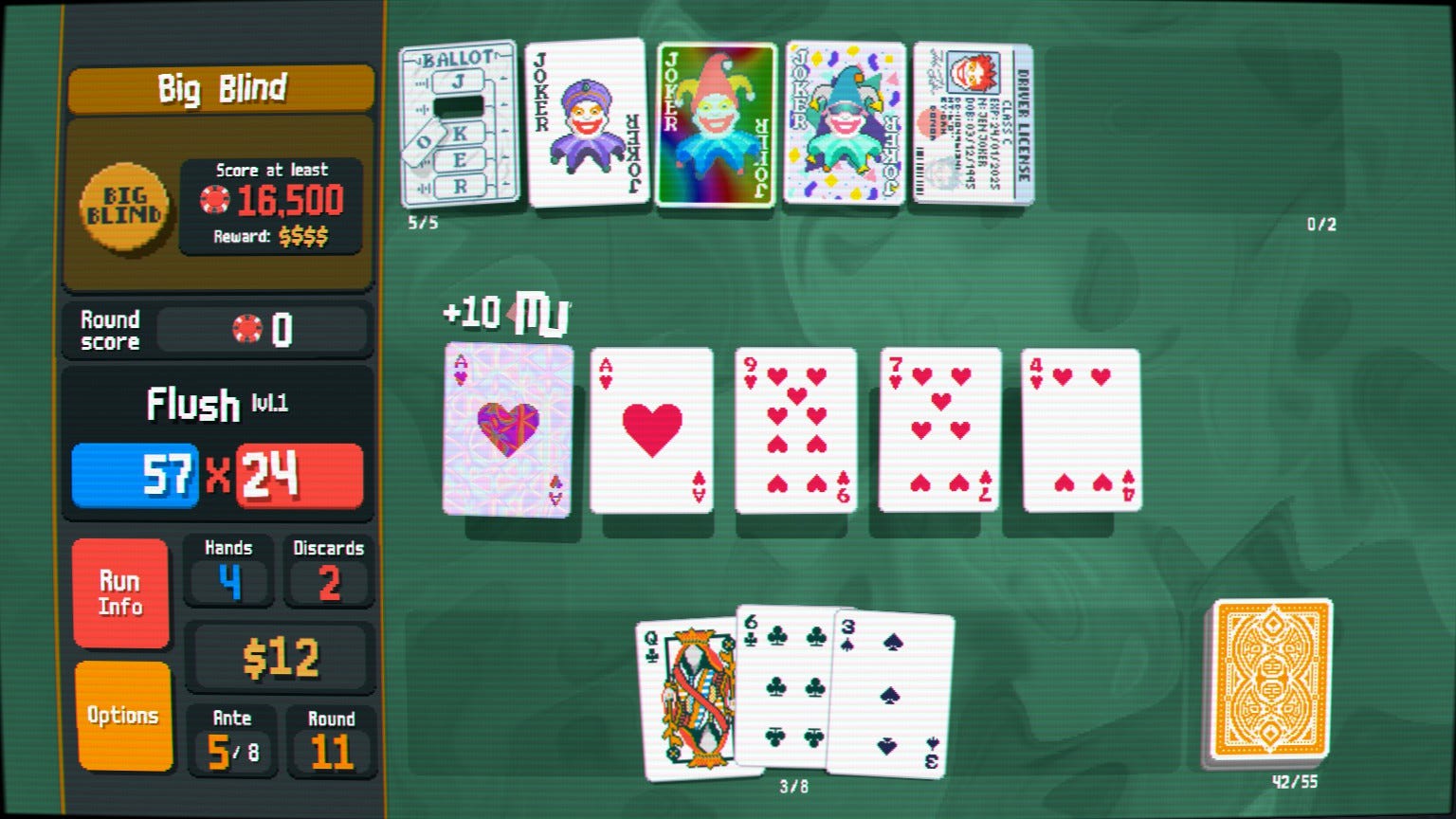
Okay, okay, I’ll be serious now. The game has some neat animation tricks. Every element of the UI is floating, slowly swaying. It’s not enough to be distracting, but just enough to make everything look alive and not static. Whenever an element is active, whether it be the score counter giving you a preview or when a card is selected, it does a very quick bounce with a subtle overshoot, which calls your attention. This happens when jokers are activated, too, which adds excitement to the interactions happening on screen, and it also lets the player know what jokers are being activated, in what order and what they’re affecting. It’s both visually pleasing and informative.
The UI in general is excellent. It’s very clean, and all the information is presented in an easy to read way. Everything is very obvious, tool tips are readable, and even with all the information on screen, it’s not overwhelming. Everything is laid out in a way that makes playing the game a very comfortable, responsive experience.
There is a lot of care put into making things look as rewarding as possible, too. Whenever something is scored, it twitches and the score bounces. The more score you get, the more it moves, and the multiplier catches fire to to show how awesome you are. Every interaction when scoring, from counting chips to adding bonuses, makes the animations a little bit faster so that long chains don’t take forever to tally, and it makes things get more frantic the more points you get. This leads to a really satisfying feeling of seeing a massive number go up and it makes your brain produce dopamine.
The sound does a lot in favor of the presentation, too. Mousing over the cards plays a very subtle click sound. When a card is selected it has a specific, rising click, and when it’s de-selected it has a lower energy click, kind of like shutting something down, to really convey the action of picking something up or putting it back down. When the cards are drawn or played, they make a really satisfying shuffling sound. All this lends a lot of tactility to the game, making it feel more responsive, even if it’s just subconsciously. It also makes things slightly more intuitive to navigate, since you can count the cards by their sound when going over them, or when you play them.
The sound goes crazy when scoring, too, lending more weight to that feeling of excitement. Every point tally has a quick ding, which gets higher in pitch and faster the more you score.
The music is great, too. It’s a very mellow, atmospheric synth track that plays forever. It’s only one song, but it’s nice to listen to. It has a very spacey, laid-back sound to it with some rises and falls. It reminds me a lot of the music in Risk of Rain 2, with how the synths sound. The song is made up of layers that drop in and out depending on what’s happening in the game. When you’re in the shop it sounds different, when you’re opening a card pack, it shifts to a different sound. All these change-ups help the song stay fresh, and they’re a really nice touch.
The entirety of the presentation is simply fantastic. The sheer number of tiny little touches and subtle flourishes everywhere are genius. It does a lot with very little, and it all goes towards making the game more enjoyable. Clear information, great feedback, excellent art direction and a very unique feeling. A shining example of visual design and User Experience.
The art for all the cards is really nice, too. I love the jokers’ gormless little faces.
Conclusion
Balatro is a fantastic example of a streamlined gaming experience. It takes a tried-and-true formula, and it gives it enough of its own flavor to create something brand new. While the deckbuilding aspect of it is a little weak, it more than makes up for it with its creative use of its limited, but well thought out mechanics. Everything works well in concert with each other and feels fair. Mostly.
My only real critique is that it feels very dependent on RNG at times. Some of the higher difficulties scale at speeds that make it hard to keep up if you don’t have the correct jokers, and getting a good build depends a lot on luck. Along with that, you can have the perfect build but then get blindsided by a boss that negates it completely. I admit that I’m not the best card game player out there, and I am willing to concede this point if someone can convince me that there are ways to win consistently, but from my experience, there’s a lot of luck.
That’s not to say this is a bad game. On the contrary, it’s really fun. It presents the player with a constant stream of interesting decisions. It’s risk/reward all the way down, and it’s all fun. Trying to form builds with the tools you’re given, developing strategies, finding new synergies. It has a lot of the staples of a good card game, and it does them well, even if they are a bit simple.
The more I think about it, simple isn’t really the word. It’s elegant. It takes all these systems, cards and scoring, and combines them to form a game that feels intuitive to play. The base familiarity with poker helps with that, too. It’s a more casual experience than Slay The Spire or some of the more hardcore deck builders, for better or worse. It doesn’t have the same crazy theory crafting and insane loops and cycles, but there is enough here to chew on. Enough weird combinations to play with.
There’s also a good amount of content in the game. There are 150 jokers, with 45 of them being unlockable. There are a lot of decks to unlock, too, and they all offer different experiences. Some change things very little, like giving you one extra discard, while others change things wildly, like a deck that has no face cards, or one with only spade and heart cards. Not only do they change the way you play, but they open the path for new synergies and strategies that don’t really work with other decks. There are also eight difficulties to unlock, and they all bring new challenges with them. It’s a very complete game.
I recommend Balatro. By now you probably already know if you like it or not, but if for some reason you still don’t know, let me be the one to sway you in its favor. It’s a fun, laid-back game that has a ton to offer with its simple premise. It’s also really cheap. You can grab it on Steam for $15, but it usually goes on sale for $10 or less. Well worth it, in my opinion.
That’s it for this week. The tables just opened, the bar is serving cheap margaritas, and I have my trusty Ceremonial Dagger ready to win some poker hands. I’m even wearing pants this time.
This is an insanely detailed review that convinced me that I’m not smart enough for Balatro. Ha! But jokes aside, excellent work.