

Day One: KILL KNIGHT
Slay bells ring

OW THE EDGE
Become a corrupted husk who must fight his way out of hell. It’s not a game about holiday shopping, it’s KILL KNIGHT, a brutal, arcade-style shooter where you fight through legions of monsters.
I’ll let you know what this is, why you should play it, and why it’s a short game with worse graphics that rules.
What is it?
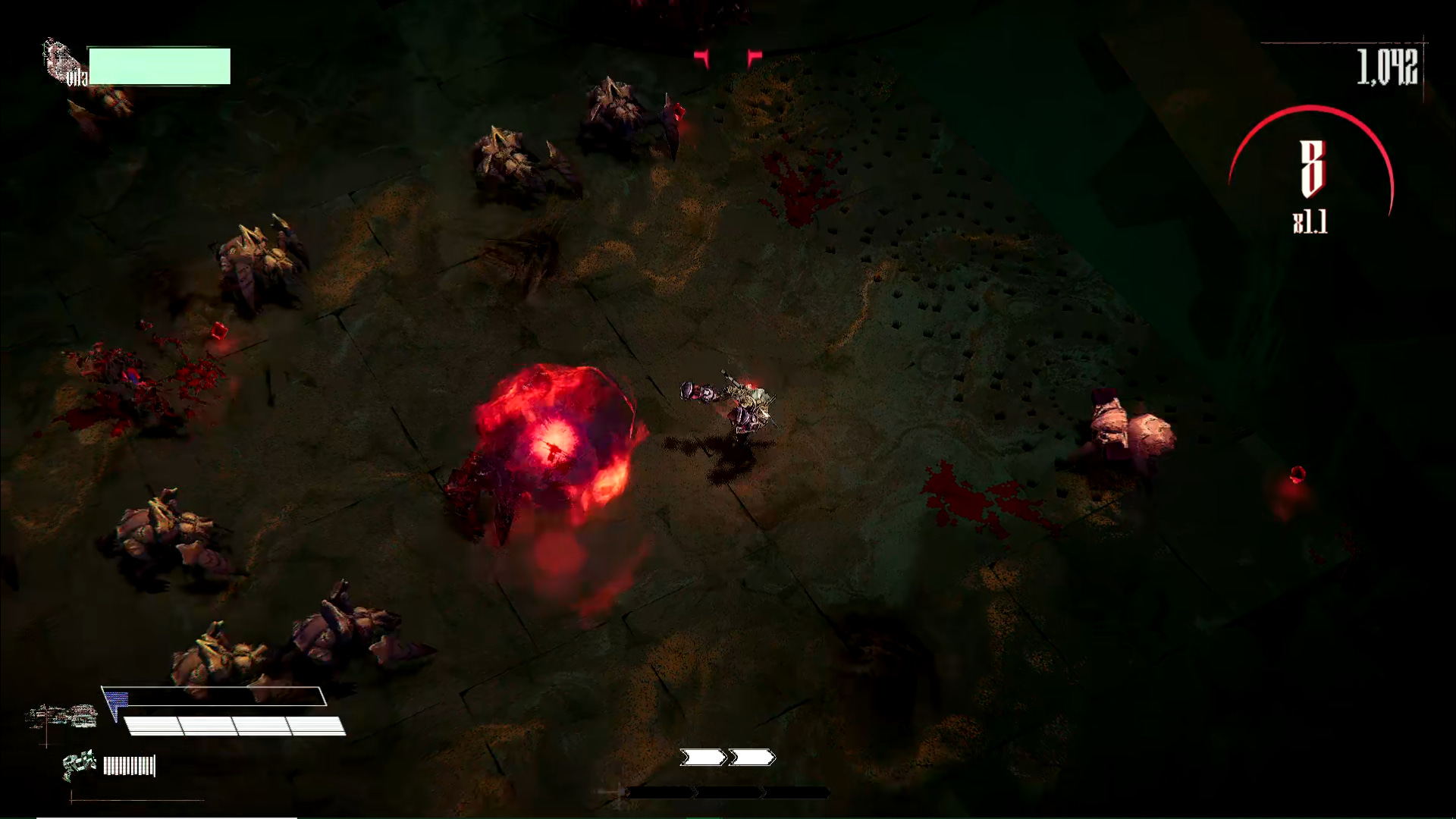
It’s a top-down isometric horror shooter. Blast your way through five stages where you fight hundreds of enemies and avoid hazards like spikes, lasers and landmines.
You have a primary gun, which has unlimited ammo and does okay damage. That’s your bread and butter, which you’ll be using most of the time. Then there’s the heavy weapon, which does a lot more damage, but has limited ammo. Rounding out your arsenal, you have a sword, to deal with anything that gets into your personal space. For really big threats, there’s the super weapon, which charges up as you collect crystals from fallen enemies.
The thing that makes these weapons interesting is the way their resources are interconnected. Your heavy weapon needs ammo. How do you get it? By killing enemies with the sword. Once enemies are defeated, you can absorb the crystals they drop, which charges your super gun, which you can use to get health crystals, and so forth. You’ll constantly be switching from one to the other based on the situation and on what resource you need. It keeps you making constant decisions, all while you’re frantically running away, dodging shots and other dangers.
Short
Five stages, each lasting from around 5 minutes, to 10 minutes for the last ones. Five minutes per stage sounds like it’s nothing, but it’s five minutes of pure combat. There’s no traversal, no puzzles, nothing other than enemies swarming you from every angle. This isn’t a survivors-like/bullet heaven, so there aren’t any pauses to pick one of three. In fact, once the stage starts, there aren’t any lulls whatsoever, no moments where the game slows down for you to catch your breath. Once you start a stage, it goes from zero to a hundred and stays there until it ends.
Don’t worry about the runtime too much, since you’ll be seeing those stages a lot. The game’s tough. If you want to beat it, you’d better get good at it, and each stage will take you a few tries. It’s manageable, but remember, this is one shot at a stage with no checkpoints.
Once you get the hang of things, you can revisit the stages for a higher score, or to mess around with different loadouts. The game has a gear system that lets you change your equipment. Customize your guns, sword, heavy weapon and armor, each gives you new ways to play, such as changing your effective range, or how you react to damage.
There’s also a scoring system. Get points for being quick, efficient and keeping a combo going through the entire stage. The chaining system isn’t very complex, but it works. You keep the combo up by killing enemies, there isn’t anything fancy to it, but there are moments where you have to plan your kills so you can keep it going between transitions. I like it, but I’m a sucker for combo systems and scoring in general.
Worse Graphics
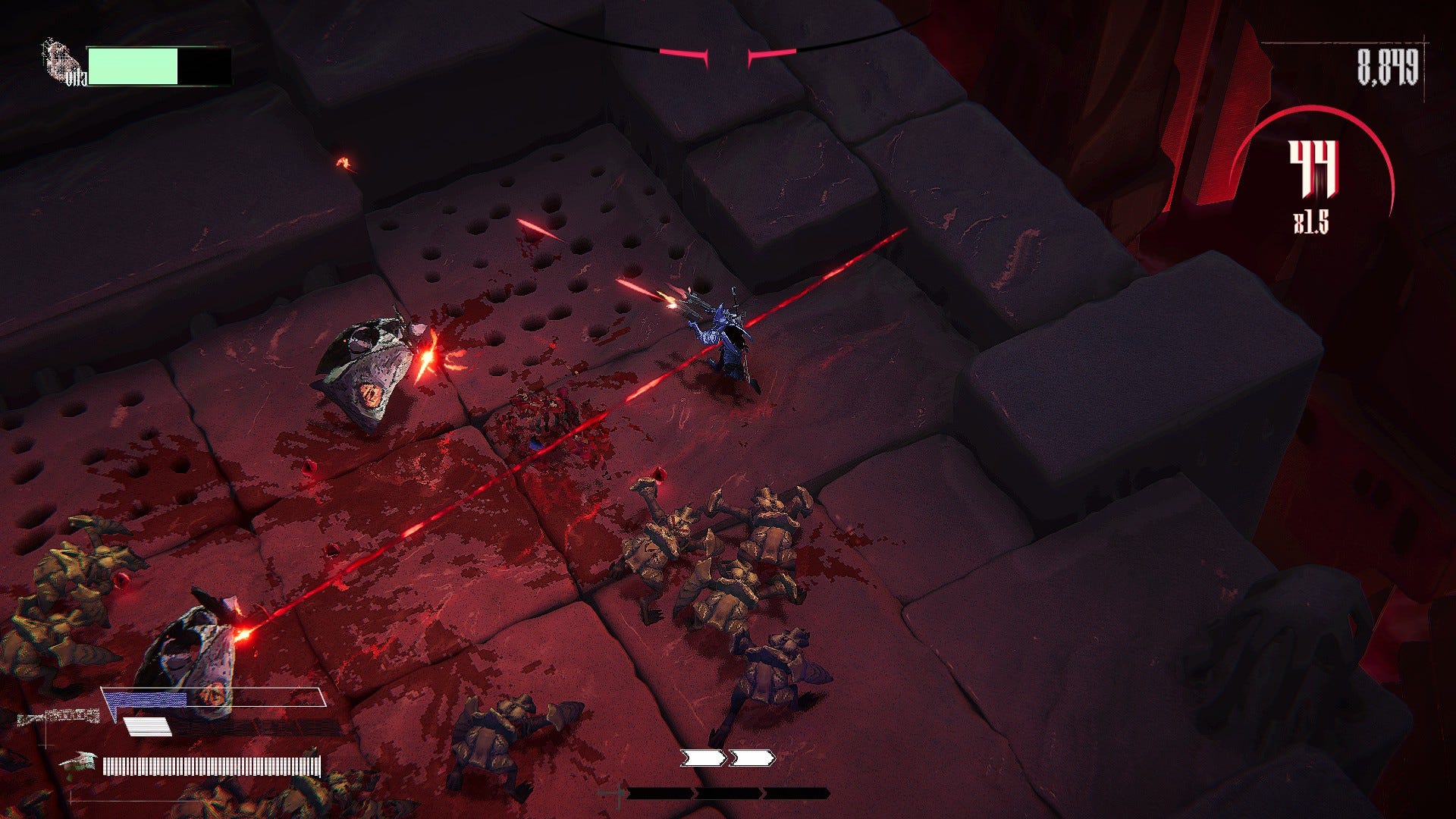
Hell is re-imagined as an abstract, geometric nightmare with low-poly models. The textures are pixelated and low-resolution, but the bird’s eye camera hides this, and makes things look grungey instead. It lends itself well to the hellish atmosphere the game tries, and succeeds, at setting up.
The dark, almost monochromatic black and red palette create a grim atmosphere, but they also help readability. The backgrounds are mostly dark, making the action on the foreground stand out more. Enemy bullets are brightly colored and saturated, so you always know what to avoid, and the enemies themselves are modeled with clear silhouettes that let you know what kind they are and what direction they’re facing at a glance. Even with a restricted palette the game manages to look interesting, and most importantly, readable, even when the screen is full of a dozen shrieking monstrosities.
The game’s lead artist, HYUU, uploaded close ups of the game’s assets to his ArtStation portfolio, so you can admire all the horrid little bug demons at your own leisure.
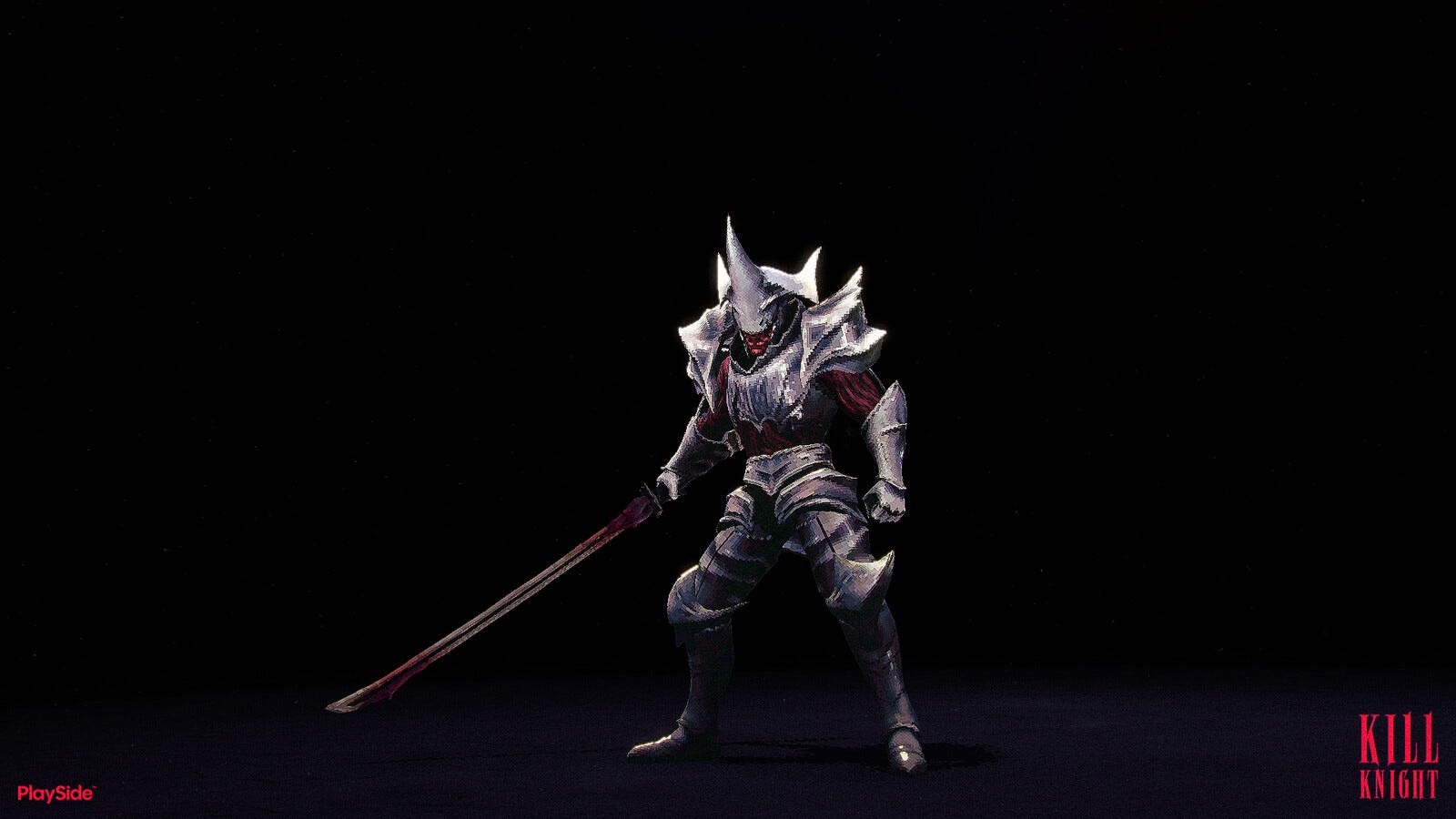
I love how the game looks. It has a very unique, stylish presentation. It’s dark, gloomy and grimey, but it’s still aesthetically pleasing. The color palette looks good, it’s readable, and I like its interpretation of hell as an abstract, geometric nightmare.
The sound design deserves a mention, too. It’s otherworldly, spooky and intense. It combines eerie atmospheric sounds with primal growling bass and an intense synthy soundtrack to create a soundscape that’s like a nightmare in a night club, in the best way possible.
Made by People Paid More To Work Less
KILL KNIGHT is developed by PlaySide studios, which is a large independent studio based in Australia. They self-publish what they develop. They have over a hundred employees. Based on what I could find, Glassdoor reports their salaries as slightly higher than average for Australia, and Indeed says they pay the average. They seem to be paid well, and their games take a while to come out. They’re working on that one 1930s cartoon mouse shooter that was announced a few years back. I don’t have any concrete data, but I think they’re doing fine. At least I’ve never heard of any misconduct from them.
Conclusion
KILL KNIGHT is a blast. It’s short, but it makes great use of its runtime, giving you a fast-paced, intense arcade shooter with a lot of replay value, and I recommend it. Specifically for those who want a tough challenge.
You can get KILLKNIGHT for just $15, but it goes on sale for a lot less.