


Up In My Evil Tower
Games have always been subject to fads. The mascot platformer craze of the 90s, Arena shooters, the World War 2 shooters of the early 2000s, the shovelware of the late 2000s, and now we’re up to our necks in extraction shooters and gacha games where you gamble your paycheck hoping to get your waifu. These come and go, and are usually forgotten, only to be brought up by Internet content creators looking for something to talk about.
I’m one such content creator, and this is one fad that’s near and dear to my heart: Tower Defense games. These were some of the kings of flash games, along with escape the room puzzles and those anime dating sims where you meet a nice girl and don’t do anything unchristian with them. Gaming trends come and go, but man’s thirst for anime girls is eternal.
Tower defense games are a mix of building strategy and an idle game. You have a map with a path on it. Enemies enter the stage, walk along the path, and try to get to the end. If they get there, you lose a life. You don’t want that, so you set up a bunch of towers outside the path to shoot them before they get to your base. The thinking part comes with what towers to place where. You press play and watch as your masterfully placed defenses tear the monsters to shreds, in a relaxing, satisfying way. It’s like setting up dominoes and watching them fall, but the dominoes are screaming orcs.
Today I’ll be looking at tower defense games, specifically the ones found on Armorgames.com. These are well-preserved, and work fine in modern browsers. Part of why I picked them is so you, the reader, can play them.
I’ll start by playing a few of the highest rated games, then I’ll talk about the lowest rated ones, for some contrast. The games will be presented with their rating on the site (out of 100) in parenthesis.
The Good (According to ratings)
Kingdom Rush (97)
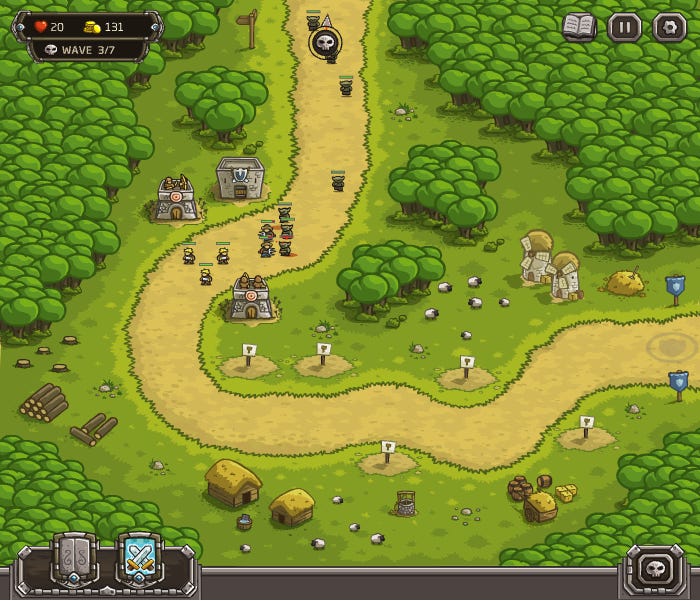
Kingdom Rush is the other well-known tower defense flash game. It has a good selection of towers, great levels and a very clean presentation that’s very “of its time”. It looks like a cross between a flash game and a mobile game, but in a good way.
Each tower has its own use, and they’re nicely varied. The arrows do constant physical damage, death by a thousand cuts. The mage towers are slow but do good single-target damage, the cannons do area of effect damage, and there are upgrades for each, which change up their properties in interesting ways.
The most noteworthy building is the soldiers’ barracks. These spawn soldiers that block the enemies’ path. These are used to create choke points. Knowing where to place these adds a good amount of depth to the game, as it lets you control the enemies. There are only three soldiers per barrack, so if there are more enemies, they can slip past, which makes you build more elaborate choke points to keep the swarms at bay.
The levels are designed to get the most out of every tower placement. There are stages with multiple lanes and simultaneous spawn points. These split your resources, forcing you to come up with creative ways to take out a lot of enemies with a limited number of towers. There are some levels where moving a squad of soldiers a few inches to one side meant the difference between life and death.
There are some levels that have gimmicks. There’s one recurring hazard that freezes your towers, and you have to click on them to free them, which is annoying. It’s more of a distraction than anything. It happens a lot in the final level.
It’s great in a mechanical sense, but its speed makes it a bit annoying to play. The levels are small, but the enemies take forever to get to the end. Each unit moves at a few pixels per day. They’re in no hurry to kill you. On top of that, each unit has way more health than they should. You can watch a single, solitary goblin waltz across an entire field of arrow towers, getting turned into a pin cushion, and he just keeps going. I felt like my towers were flicking rubber bands at them. Every level is a multi-minute slog where you sit there and watch everything play out in slow motion. There’s no fast forward option, either.
The game’s well made, and a lot of fun, but its sluggish speed kept me from loving it. Some of the later levels are demonic, with waves of hundreds of enemies. Then, as it happens in every one of these games, there’s the obligatory difficulty spike. This was usually one wave in some levels, where you suddenly get washed by a tide of orcs twice the size of the previous wave. I would retry a problematic stage, bored out of my mind, watching hundreds of monsters die of old age, just so I could get to wave 49 where the real challenge was, and see if I could survive it. If I didn’t, it meant another 10 minutes of waiting.
Gem Craft (95)
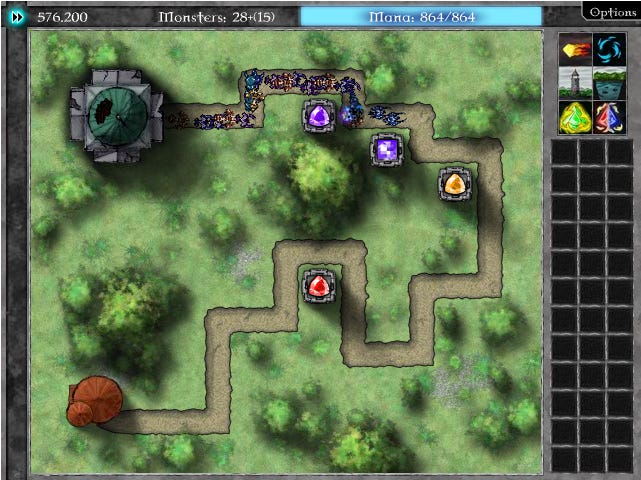
In Gem Craft you craft gems. Take different colored gems, smash them together, and make powerful towers to stop monsters. It’s great… in theory.
I remember this game from back in the day. I didn’t like it. It was a bit too convoluted for me. Instead of towers, you have a bunch of gems with different colors, each with a different effect. The red gems shoots fast, the green gem inflicts poison, so on and so forth. They all have the same shape, and it’s confusing at first. I had to keep hovering over each gem to find out what it does, and if I wanted it. After a few minutes, I gave up, and didn’t try it again. Now that I come back to the game as an old man, did I change my view on it?
At first, I liked it. After groaning through the first few levels, asking myself “what does this thing do, again?” and wrestling with the weird mechanics, I found I was having an okay time. I didn’t see much of a difference with the gem combos, but I was willing to look into the game more.
Your gems are limited in the first few stages. You get two or three colors, and you familiarize yourself with them. As the stages progress, you get more colors to work with. It sets up an interesting difficulty curve.
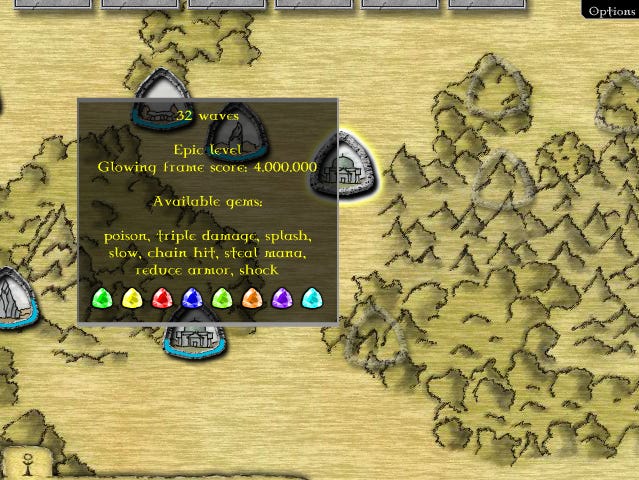
Then comes the difficulty spike, the one all of these games have. This one is the “epic” boss stage. It’s a regular stage, up until the last three waves, where all Hell breaks loose and you have to take out hundreds of invincible enemies, then fight a boss. That’s when I lost patience with the game.
The gems are alright at first, but there’s one problem with them that becomes apparent when you actually need to place them: They’re randomized. Every time you buy gems, you get random colors. That means random towers, which means random effects. If I want the purple gems, that lower an enemy’s armor, I have to buy a batch of gems and pray that I get the one color out of eight that does what I want. It’s infuriating.
Even if I get the gem that does what I want, it does it poorly. It’s like finally hiring someone as a chef, but they only know how to heat up ramen noodles. The purple gem has a percent chance to strip armor. A chance. If you upgrade it to a high level, it goes up to 20%, which is a one in five chance of stripping armor, when you need it to strip armor 100% of the time. When things get hectic, this thing hits an enemy once or twice, so its effect is lessened even further.
The solution is to get a bunch of purples, but that just brings me back to the original problem. I have to gamble for them.
Ah, but there are area of effect gems. Splash attack and chain attack. I can combine the purple gems with those, and get area of effect armor reduction! Or so I thought. These special gems apply their effect to the first target they hit, so no cheeky area of effect armor dissolution. What? You thought this was a well thought out mechanic?
The first few levels come down to placing towers at the start of the level and slamming gems together to level them up. No real consideration to placement or gem types. Just mash whatever you find, put them near the enemy’s spawn and press “next wave” over and over and watch the enemies get decimated. Then, in the one level where you have to play smart, none of it matters.
This game is very highly rated, and I remember it being one of the most well-regarded games back in the day, too, but I don’t get it. I will admit defeat and say I couldn’t get past the boss level. I tried and tried, but nothing worked. I tried getting a bunch of towers, getting a concentration of high-level towers, focusing on purples for anti-armor, creating massive choke points, hoarding lives to give the boss two laps around the stage. Nothing worked. No matter what combination of gems I used, the third to last wave waltzes past my towers, taking nearly no damage, and the boss comes out, gets pelted by every single thing, and doesn’t even get to half health. Every wave before that gets destroyed before they can even pass the first bend, but those last ones beat any strategy I could come up with.
The game has a scoring system, and each stage has a high score to beat. This makes me think there must be something more to it. The better you score, the more skill points you get to level up skills. They don’t matter much until higher levels, where you get bonus damage to your gems. Stuff you need, but you unlock it late.
With all that said, I gave up on GemCraft. My opinion on it didn’t change much, but it’s more refined now. It’s like the difference between spoiled milk and cheese. My first opinion was stinky, and so is my second one, but the second one has a more complex stink to it.
Cursed Treasure (94)
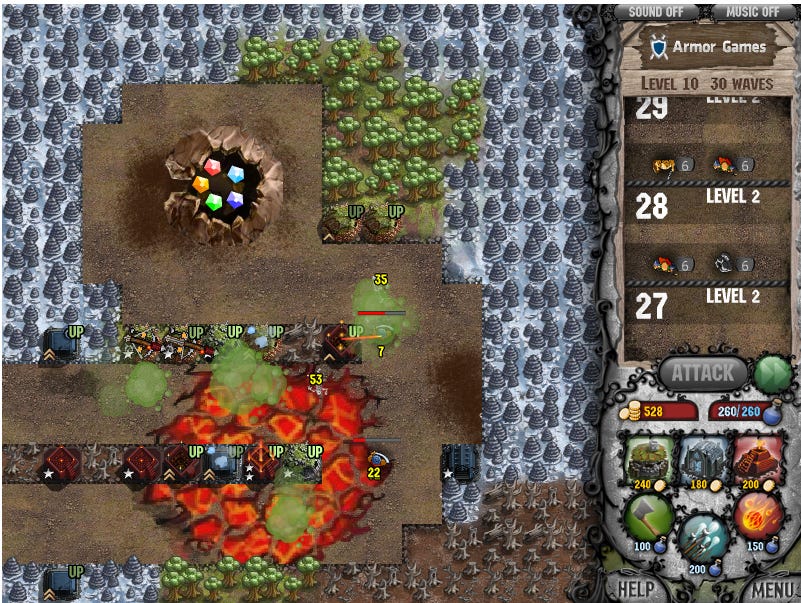
Cursed Treasure is a solid game. It tries to get fancy with its different terrain types and a mana system, but they don’t complicate or convolute the game. It has an interesting set of enemies that require different tower configurations. There’s also some spells you can use, which cost a ton of mana and aren’t really very useful, but hey, they’re there if you want them.
The way the game handles the player’s lives is a more interesting innovation. Instead of taking damage once enemies get to a certain point, they instead carry gems out of your base. Enemies have to go in, take a gem, and exit the stage, taking damage all along the way. If they die while carrying a gem, they drop it, and another enemy can then pick it up. This makes you rethink your tower placements in a dynamic way, setting them near any gems. It also adds a ticking clock element, since the distance the enemies have to travel with the gem gets shorter every time they pick it up. It’s a cool variation on the lives mechanic.
Each tower can only be placed on their specific terrain. Arrow towers on grass, crypts on ice and fire temples on rock. This seems like it might limit your choices, but this tiny mix-up adds a good layer of decision making. Your tower placement choices are limited by type, but instead you focus on which ones to place first, and which ones to upgrade. This also forces you into making hard decisions on making the best out of a sub-optimal option.
There are also high ground placements that give extra range to any tower built there. These have no terrain restrictions, meaning you can build any tower on them. You can have AoE towers that cover a huge area, or make sniper nests that rain arrows on enemies as soon as they appear.
The balance is all over the place, like it is in most of these. It’s easy going for the first few levels, then there’s a massive difficulty spike at level 9, then it goes back down to easy with some levels having one wave that can end you if you don’t prepare for it.
I think the lopsided balance could be due to the tech tree. It has a progression system, because of course it does, every one of these apparently needs one. The upgrades are boring; plus 5% to damage, small incremental stuff like that. Then at the end there’s one that adds a special effect to towers of that color. I went with the green tree, because it offered more gold. It has a poison upgrade, and it makes quick work of most things in the game.
Outside of its alright gameplay, the most memorable thing about this is the sound design. When you build towers, you get this admittedly satisfying hammering sound effect. Build a lot of towers, and it sounds like you’re in an old-timey shipyard. Whenever you kill an enemy, they do a cartoonishly loud death scream. It sounds like they recorded someone getting a safe dropped on them. The hilarity of the sound effects is canceled out by the droning 2-second loop they use for the music. It’s the kind of low-level water torture the CIA would use as a complement to their more advanced interrogation techniques.
Day of Meat (94)
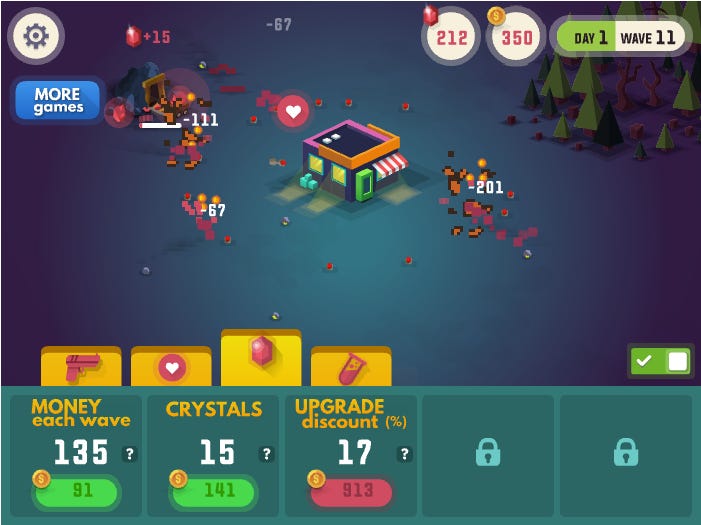
Day of Meat isn’t even a tower defense game, it’s an idler. You have one building, it shoots automatically, monsters come in and you die. You’re supposed to die. You get some money before you die, and you use that to get upgrades so you can last a little longer next time. Then you die, and repeat the process. That’s it.
There’s no real strategy to this. Given some time and training, a chimpanzee could fumble its way through this one, but having a chimp play this would be considered animal cruelty. There’s nothing to this game. In fact, I hesitate to call it a game. It’s a widget you click on every now and then and it makes noise while numbers go up. It’s a Skinner box. The kind of thing you have open in another tab in the background while you’re supposed to be working, but every other game on this list- well, almost every other game- does that better. They have something for you to do.
I don’t like this, and I don’t know why it’s so highly rated. It’s from 2019, too! Over a decade after the tower defense craze, and it’s worse than the others.
Bloons (85)
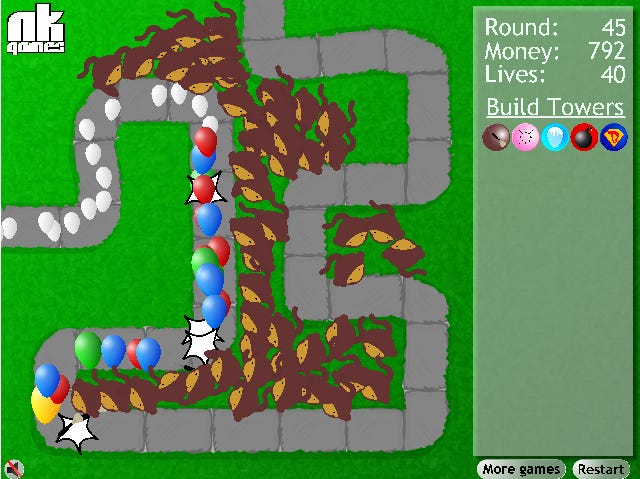
Bloons TD is probably the one most people know. A nostalgic staple for zoomers, but its first outing was a very simple thing. You have the monkeys, and they really hate balloons. Place monkeys to shoot the balloons.
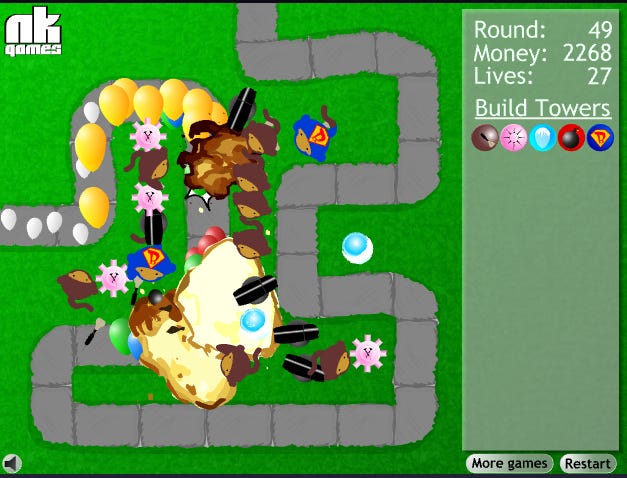
There are different towers, but none of them matter. All you need is the dart monkey. Shove them in the middle of the map like you’re trying to compress them into a space-saving brick, and let them go wild on the bloons. Add as many as you can after each round, and you’re good to go. You can get through all 50 waves without losing a single life.
This is a very early attempt at a tower defense game. Not chronologically, since this is from 2008, the same year as Gem Craft and others, but it’s still pretty early. It makes a lot of mistakes that were corrected later on. The tower placement is too free, letting you pack monkeys like sardines, the enemies are too simple and it relies on just throwing a bunch of them at you.
The one map you get is very simple, too. It’s a winding path with too many corners and a double path in the center. There is no real wrong place to put a monkey. The middle is more effective, since the towers can focus fire the wave in two directions, but you can place them almost anywhere and you’ll have a lot of the track in the monkey’s range.
The second game in the series fixed a lot of these problems. More complicated maps, varied enemies that require different strategies, more difficulty settings and all that, but that’s a topic for another article.
Defend Your Honor (84)
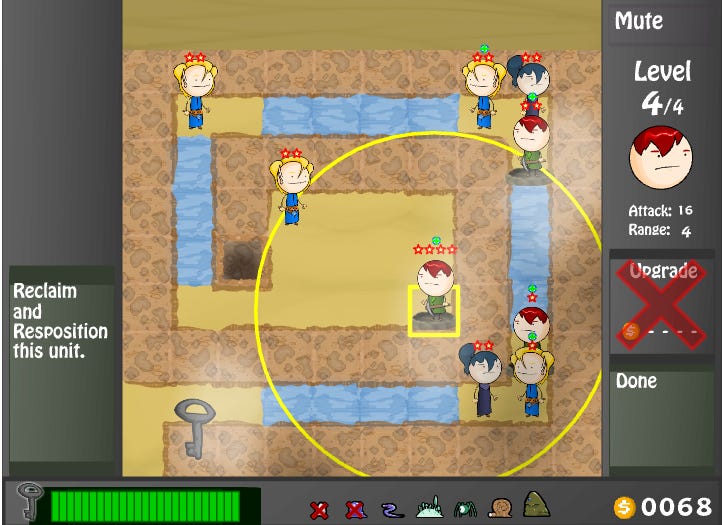
Defend Your Honor can be described as easy, prescribed, pre-solved. There’s nothing to this game. The fact that it’s rated 84 means these ratings have no weight to them. Well, I should have known that when they gave Day of Meat anything above a 10.
This game’s gimmick that you buy units before the level starts. You get them at a shop, then place them at the start of the stage. You can place every one of your units at once. Once you do that, the level is solved. There isn’t any on the fly decision making, no adjusting your strategy, just place your guys and they do their thing. Not much else to do other than upgrade the units.
You can get away with this thanks to the game’s many flaws. the levels, for one, are mazed poorly. You can’t place towers wrong. The stages swirl and curve like pasta, making a tangle of closely-knit paths. You can place a tower anywhere, and it will always be at maximum efficiency, with tons of track underneath it.
If the stages weren’t bad enough, there’s also an issue with the tower’s ranges. When upgraded, they all have absurd ranges. They can hit anything from anywhere. If you thought you could maybe possibly make a mistake with your tower placements, you can’t. I’d have to double-check, but I don’t think there’s a single tile in any level that’s a bad spot.
The game describes itself as: A mixup of the Tower Defense with a dash of strategy. I wanted to create a tower defence game that didn’t become stagnant, so each battle is short and sweet, and feels like a smaller part of the grande scheme of things, rather than wave after wave of repetition. The strategic placement of units is the key to victory!
This isn’t strategic. It’s the opposite. Throw all your units on the map without rhyme or reason, and you’ll get through the level. It’s completely stagnant, since you solve the level before the first wave spawns. You come with the same number of units, in the same configuration, throw them anywhere on screen and you win.
This game shows the importance of spacing through its absence. The maps are small, and the unit ranges are massive. Any unit can hit almost any point in the map from anywhere. Even the more “strategic” units, like the cleric that buffs nearby allies, or the bard that slows enemies, can be placed at random. Upgrade them enough and they can do a good job from wherever. Ideally, you’d want the bard at the start of the course or at choke points to cluster enemies up, but you can place them at the end of the track, and after a few upgrades they’ll be at maximum efficiency anywhere.
I tried doing the final stages by throwing towers onto the map at random, and upgrading them at random, and I managed to beat the game. Didn’t lose any lives with that technique, either. This stinks.
The Bad (According to Ratings)
Picnic Panic TD (29)
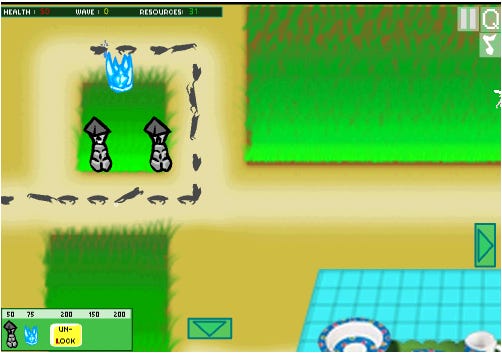
Picnic Panic is the mirror opposite of Defend Your Honor. The only thing they have in common is that they’re both bad. Instead of small maps, you get one large map with 4 screens. With a map this big, you’d expect your towers to have a similarly large radius, but no. The game goes a truly innovative route by giving you towers with microscopic range. You’re fighting ants, after all, so it makes sense. The towers were too strong in Defend Your Honor, and here they’re useless.
Nothing has any explanation as to what it does. The towers have names that imply what they do, but there isn’t any real information. The ice tower is the ice tower, it seems to hit in an area and you’d expect it to slow enemies, but it doesn’t seem to do any of those. You take it on faith that it’s doing that, because none of the towers do much in general.
The worst thing about this game is that it’s boring. The towers feel limp, and everything happens in one map. If there is another map, I didn’t see it, because I couldn’t be bothered to play this for more than a few minutes.
Ammo Towers (25)
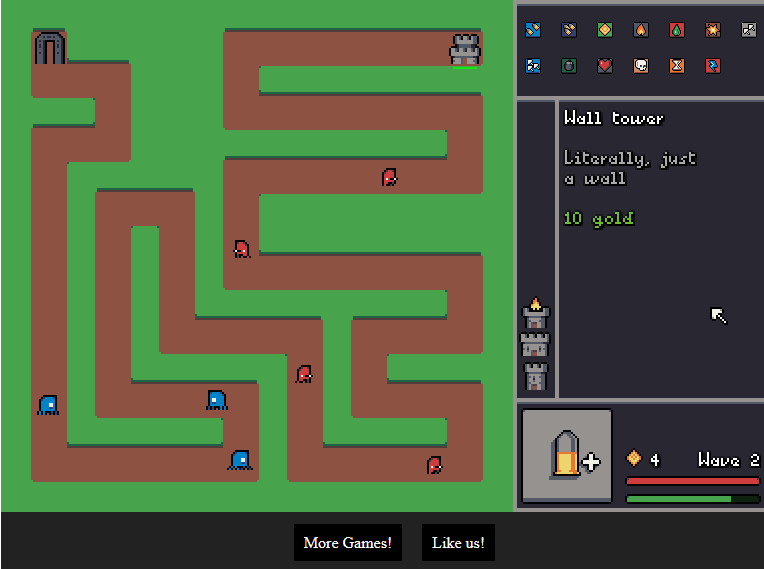
This is the lowest rated tower defense game on the entire site, and I can see why. This is a very basic tower defense game with one grating gimmick: reloading. Yes, everyone’s favorite thing in the universe. Stopping the action to reload. This guy must’ve been a huge fan of Bioshock. You place towers, they shoot, and as they shoot they consume ammo. Click the ammo button repeatedly to reload them.
The game leans heavily into the idler side of tower defense games. When you die, you keep your money and upgrades, and try again. You’re supposed to keep dying over and over until you can keep going.
There isn’t much for me to say about this game other than “it’s bad”, and I already said that, I think. The other thing I can say is that this was made in 2018, a full decade after some of the others on this list. With this and Day of Meat, I can say there’s proof that games have been getting worse.
Miscellaneous
Grid Forge TD (76)
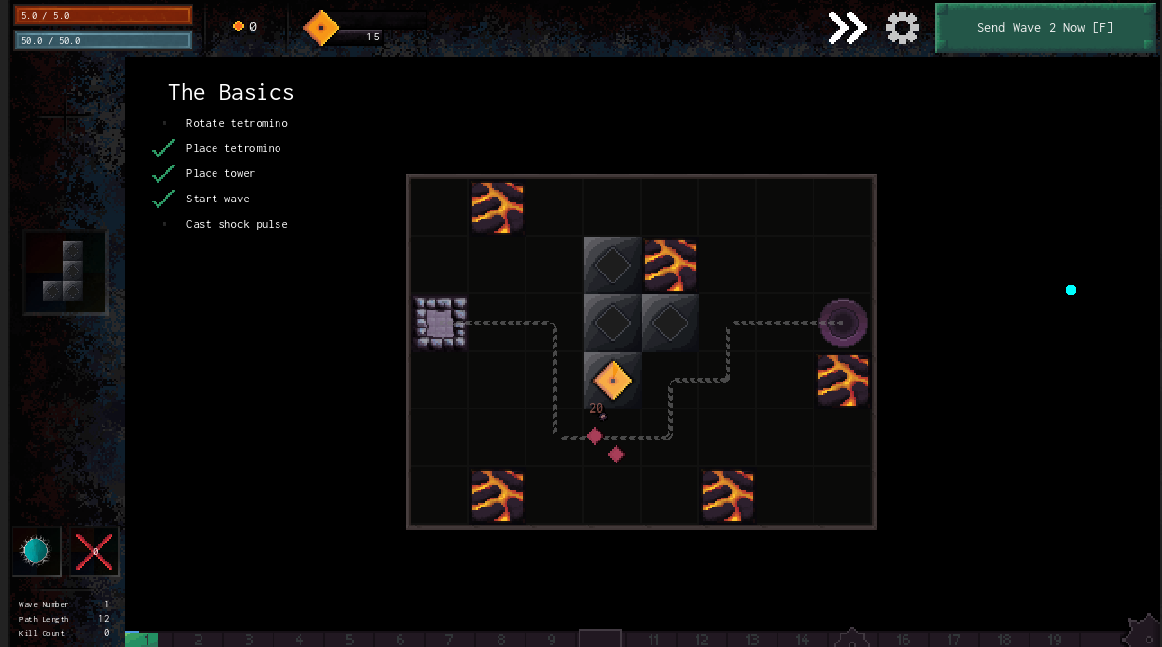
I sorted the games by “newest” and found Grid Forge TD, uploaded in December of 2025. Sure, it’s a demo for a Steam game, but still, it’s a browser tower defense made in our Lord’s year of 2025. I know there are tower defense games still being made on Steam. If you think of any dead genre, there’s a good chance there’s an indie dev making a new game for it (except MMOs. Those are gone.), but the novelty factor is still there, and it’s enough to get me to try it.
It’s the only TD I’ve covered here that has mazing, which means you create the level. You place obstacles that influence the enemy’s path, so you can make them zig zag around and take longer, more winding paths. This is neat. It adds a new layer of strategy.
I started the first level, placed a block, put a tower on the block, started the wave, and I promptly died. You get 5 lives. The second wave has 5 enemies, which you can barely get by with one tower. The next wave overloads you, and kills you.
I took stock of my options and found there’s a shock ability you can use by clicking. It costs mana, but you can spam it for a bit until you run out. It’s necessary to clear the first waves, since your single tower isn’t anywhere near strong enough to do anything on its own. I don’t like getting mechanically involved in tower defense games. Most of the satisfaction comes from seeing a well-laid plan playing out. In Grid Forge, I had to click on the enemies, cleaning up my tower’s incompetence like I’m its mom.
The next wave came along, and I could finally afford a second tower. Golly gee, I get two whole towers. How generous. The wave started, I clicked at the enemies while my towers dribbled shots at them, I was overwhelmed and died. Now there wasn’t anything for me to do there. I had clicked until my mana was dry, and even if I had optimized everything down to the pixel, I would have been left with over seven enemies to deal with at the end.
It was then that I felt an itch at the back of my head and looked at the tags. Incremental. Oh, it’s one of those. I dislike progression and tech trees because, most of the time, they lock the cool stuff behind arbitrary grinding, leaving you to fumble with the inadequate basics. They have to make your basic stuff bad so you’ll want to play more and upgrade them. Incremental games take this concept to its absurd finale. You need to progress to unlock the basic stuff. Instead of starting at a power level of 1 and working up to 10, you start at -5 and claw your way up to 1.
You’re supposed to die in the first few runs. Only then can you get the meta-progression tokens to unlock the numbers you need to clear the first waves. Then you’ll get to a point where you can’t progress anymore, die, and use the tokens to clear that hurdle. You’re not limited by skill, you’re artificially limited by time.
Wasteland Defender (69)
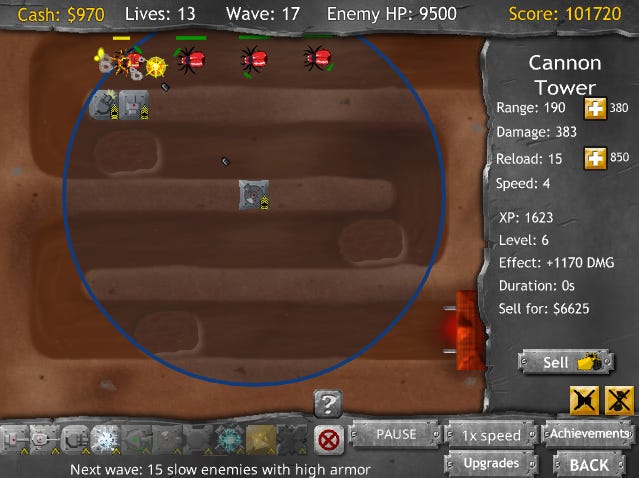
Wasteland defender. This one seemed promising at first. Good tower variety, interesting enemy compositions, decently designed maps, that sort of thing. It was easy at first, but I kept going to see if there was a difficulty spike, and there was. There was a massive spike the size of the Seattle Space Needle at the second to last map. I was ready for a challenge.
The game has an upgrade system like the other games, but this one resets after each map. You can upgrade stats like all the tower’s fire rate, range and damage, along with more technical things like their experience gain and money generation. You get a point after each wave, so you use them to scale and plan ahead. I liked this feature a lot. It gives you a sense of progression, but it doesn’t limit it to the wider game, which means you don’t have to grind multiple levels across different maps just for some stat increases.
The difficulty spike map made me min-max the progression. There’s also an achievement mechanic, again reset on a per-map basis, that awards you with extra money if you hit certain milestones, like a specific number of enemies killed or a number of towers built. After losing a few times, I started planning my builds around those monetary bonuses. I was deep in the numbers.
Even with all that I kept failing. I tried different tower combinations, and managed to get further, but there were waves with a ton of heavily armored enemies that could take an entire war’s worth of ammunition and survive. I couldn’t crack it.
They say the definition of madness is doing the same thing and expecting a different result. There should be a second definition: spending too much time varying the same process to a nonsensical degree. It’s like if you find you don’t like spinach, but you try different dishes to see if you like them, hate all of them, then you start making batshit insane dishes to convince yourself you might like spinach in some configuration. Maybe you mix it with Fruity Pebbles and mayonnaise. If you iterate through the near infinite possibilities, you’ll eventually stumble on a configuration that works. That’s where my head was at with this game. I started throwing down towers at random and trying insane builds to see if I could glimpse some hidden truth.
Then I did something no sane man would do: I read the comments. On purpose. There I saw one guy who had a simple recipe, one that would make me like spinach once and for all, metaphorically speaking: build a cannon tower, upgrade its fire rate seven or eight times, then max out the fire rate skill.
Once I did that, the game stopped being a game. The cannon deals a ton of damage, but it’s limited by its slow fire rate. You can upgrade the fire rate to the point where it becomes a machine gun, completely invalidating its drawback. Once your cannon is firing 30 shells a second, you can upgrade its range to cover the entire map. Now you have a rapid fire mortar. The damage it puts out is so unhinged, that it can take down those overpowered boss waves on its own. It goes from a cannon, to the solution to every problem in the game.
Now this has the same problem as Defend Your Honor. Your cannon is too strong, and it can shoot anywhere on the map. The element of strategy is gone. Sure, this one isn’t very obvious, but it’s there. Once you see it, you can’t ignore it. In fact, some of the waves in the last two levels get so absurd that the only way to beat them is to do this tactic. This makes me think it’s the intended way to play the game.
Getting an overpowered build and breaking the game is kind of fun at first, but it’s dumb. This only works if there are different, interesting ways to overpower the game. You have to work for it. If you find some niche synergy that turns you into a god, you feel powerful. If you can press the “make me strong” button over and over again, you’ll get bored real quick.
It’s a real shame, though. The game was decent, up to that point. The developer put thought into a lot of the mechanics and how they would work, but left that glaring flaw in there. I say it’s a flaw, because it completely ignores 90% of the game’s systems, but like I said earlier, some of the waves later in the game seem like they can only be stopped with a few rapid fire nukes, so it might not be a flaw. Either way, I don’t like it.
Conclusion
I recommend Tower Defense games. Some of them, at least. They’re a neat little genre with some interesting ideas, that were probably all explored back in their day. The good ones inject a good amount of strategy and problem solving into the mix, making you think about optimal tower placement and compositions. The bad ones are broken, boring messes at best, and idle clickers at worse.
It’s a simple genre that can either be good or bad by messing with a few numbers. If you make the towers have too much range, you get rid of the need for decision making and smart placement. Make your towers’ range too small, and no matter where you put them, it’ll be wrong, and it’ll make you feel bad. Something as simple as the number of turns on a map can make it go from a tactical challenge, to something so easy, a bonobo ape wouldn’t bother with it.
If I could pick and choose from these and dream up some tower defense of my own, here’s what I’d do. I’d take the map design and tower variety from Kingdom Rush, but I’d make the enemies way less tanky. I’d give it some more complicated enemies, like the ones in Cursed Treasure. The enemies in the latter are good, if you’re not shooting them with an omni-ranged mortar.
Range is another aspect. It represents spacing. I’d have towers that have medium ranges, so you’d have to overlap properly and think about making chokepoints, and not just littering the outside with towers.
Personally, I’d get rid of the progression systems. I don’t care for meta progression, and tech trees that give you +5% to damage. Get rid of all that. Have each map be its own thing, have the sense of progression come from upgrading your towers on a per-level basis.
There should also be wrong answers. Spots on the map where, if you place a tower, you don’t get much out of it. Make the player think before putting something down. On the flipside, make several spots that are too good to miss out on, so the player has to weigh which tower would be best on those limited golden spots.
I could get into the economy of these games, but that’s getting really deep into the technical details, and I’m not qualified for that. Make sure the turrets aren’t too cheap, nor the upgrades. With the money, it always seemed strange that it’s tied to how many enemies you kill. If you don’t kill any, you don’t get money, and how are you supposed to fix your formation without money?
I like the genre, but I think it’s run its course. There are ways to make good, new ones, and some ideas to play around with, but I haven’t seen many that do anything worth mentioning. Except for one which will be discussed later. Not many of the new ones that I’ve seen seem to be anything new. Sometimes it’s okay for a genre to come and go. There’s a time for everything. A time to sow, a time to reap, a time to play Quake 3, a time to play Fortnite, a time to play Tower Defense games, and a time to play whatever flavor of the month happens to be in vogue.
If you have any more tower defense games to suggest, let me know in the comments, and I’ll make a part three. Part three? Yes. Part two will be focused on Bloons. There are some tower defense games on Steam I haven’t checked out, and some less traditional popular ones like Orcs Must Die and Sanctum.
Yeah TD games are better than what they lead on. Simple but very effective that anyone can enjoy and they don't necessarily skim on gameplay elements.
I'm surprised you didn't mention Nikke's Tower Defense minigame. You've mentioned it in previous reviews of other unrelated games. That game is pure fire but I understand that it's a Nikke minigame and not an actual standalone thing. They really should get to releasing minigame compilations for a few bucks.
"Every time you buy gems, you get random colors. That means random towers, which means random effects. If I want the purple gems, that lower an enemy’s armor, I have to buy a batch of gems and pray that I get the one color out of eight that does what I want."
Hang on a second... wouldn't that make it a roguelike, and a deckbuilder at that? I thought you were reviewing tower defense games, you fraud.
I liked Sir, We Have an Orc Problem during this most recent Next Fest, but it is technically an incremental meta-progression game bolted together to a TD game so you'll just complain about that. But I also really liked America Against Ants from last year's Next Fest, which is apparently coming out in a couple months. It's basically a tower defense game that has a little bit of very rudimentary RTS to it, where all of your 'turrets' are RTS units/squads that you can move around, and they take a little while to get to where they're going and set up their firing cone, and each wave of ants might spawn from a different direction or take different paths or have more heavies so you have to reposition and set up crossfire and take advantage of alleys and it makes lighter, faster units genuinely helpful for zipping around reinforcing spots under more pressure than you expected. A lot of cool little features too, like the fact that you can take down buildings in some maps to open up more lanes and sightlines, eventually you get call-ins that you can trigger a few times per mission like pheromone lures and air strikes, and you can call in waves manually, even back to back, so in the last mission in the demo I called in like the last ten waves all at once and dropped a nuke on them. Sick.