Quantified Fun
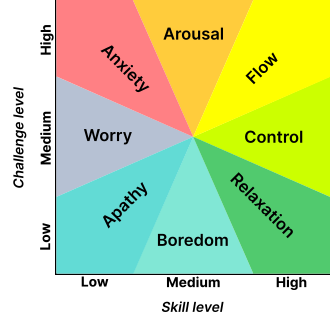
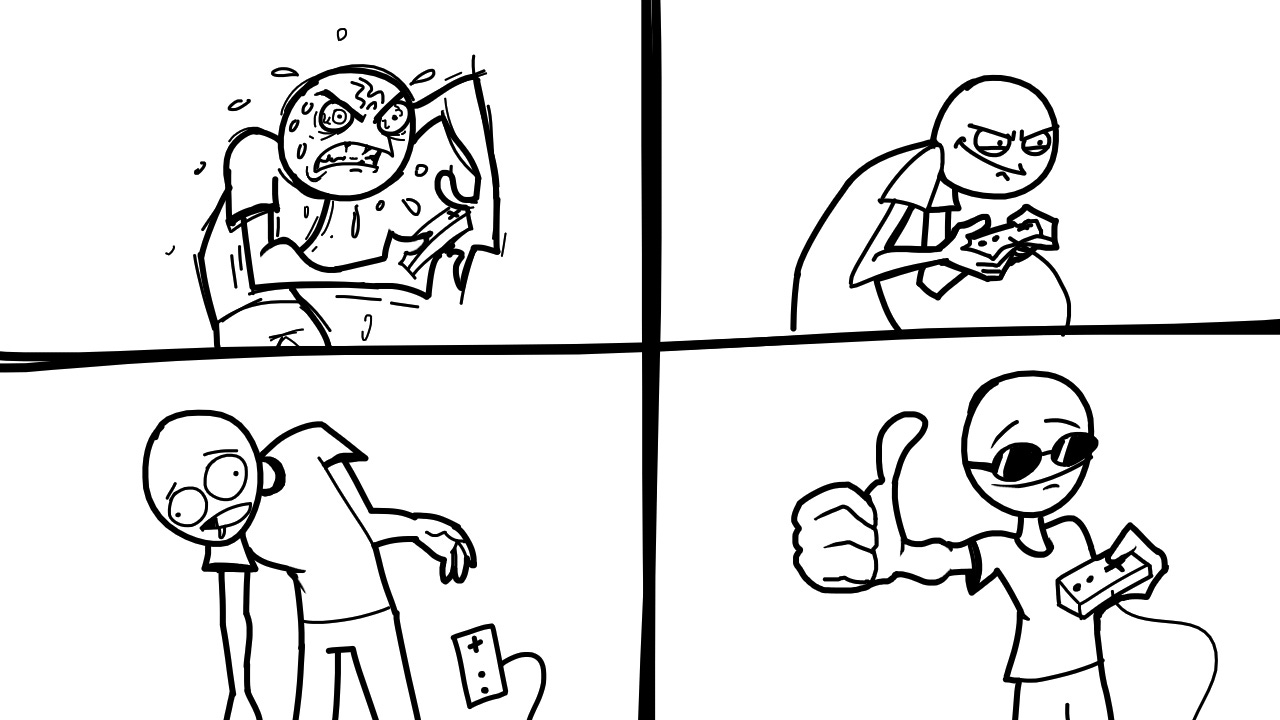
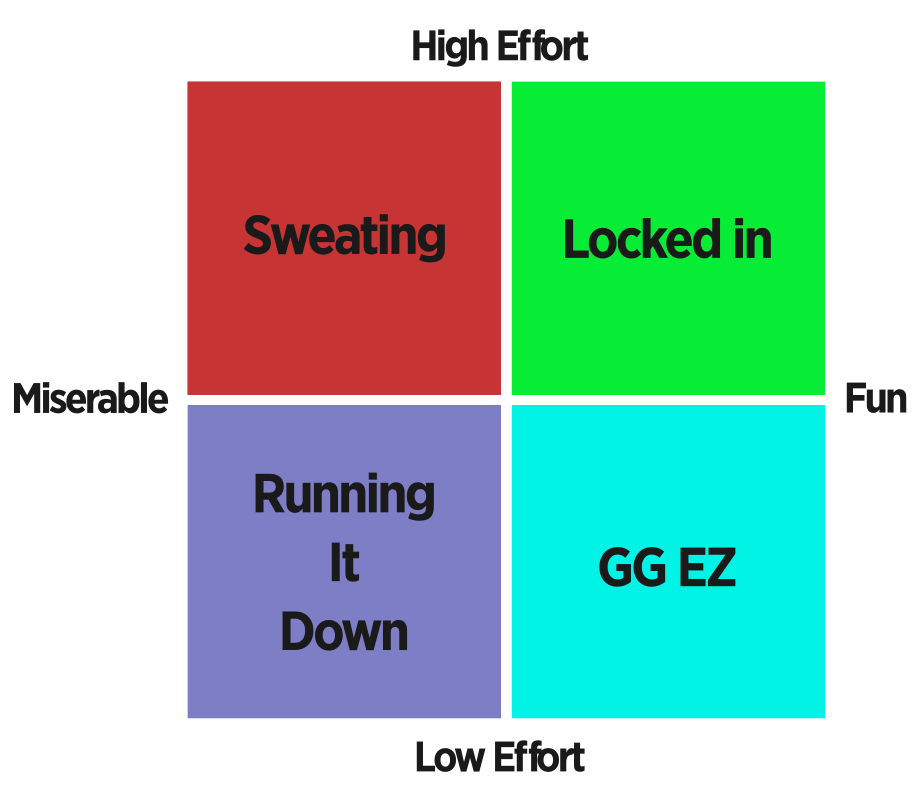
A while back, I wrote about the 4 Types of Fun. They were originally 3 types, with the third type being “no fun at all”, so not really a type of fun. I didn’t make the rating system, it was made by someone else, and I adapted it to videogames. It was mostly about how you feel during and after the event, but recently I came up with my own chart. It’s split into four quadrants, with two axes, because it makes more sense and people online seem to like this sort of thing.
Effort Axis
How hard are you trying? High effort means you’re doing more than usual. It might be that your actions per minute are higher, you’re pressing more buttons, exerting physical effort. It could also be mental effort; you’re actively thinking through your best strategies, trying to outplay your opponent or the game itself, thinking five or six steps ahead. Using 100% of your brain to focus on one thing, with no distractions. It could also be a combination of both mental and physical strain.
There are a few games that come to mind here. Granted, it’s when they’re played at a higher level, but they demand more from the player at a baseline. Super Smash Bros. Melee is a good example of mechanical effort. When played at a semi-high level, you’ll be wave dashing, which needs three button presses to complete, over and over again. If you’re not doing that, you’re probably dash dancing back and forth, waggling your joystick from side to side, with an obvious dick joke here. Even playing neutral in Melee puts a strain on your controller. There’s also a mental component to the game, with outplays and predictions, sure, but I’m focusing more on the mechanical aspect.
Games that require a lot of mental effort are usually turn-based. The most obvious one that springs to mind is Chess. Every move you consider has dozens of alternate paths you can go down, and it gets more convoluted the further ahead you plan. You can stew over how to move one of your knights for an entire minute, suddenly find the perfect move which will start an avalanche of trades, only to make the move and realize you just left your Queen open and you flip the board. Unless your games devolve into fist fights, Chess doesn’t ask much of you on a physical level.
For a game that overheats your mind and body, I’m going to skip the obvious StarCraft shoutout, and go for Quake 3. Dueling in Quake is a test of every skill you could have while playing a game. You need spatial awareness, to know the maps, where you are and how to navigate them at high speeds. Know the optimal paths between power ups, the best angles and what to avoid, where the weapons spawn. You also have to keep track of where your opponent is at any given point, and predict where they might go. While all this is happening, you have to keep a running timer in your mind for when the power ups spawn. Whenever you fight your opponent, your aim and movement are put to the test. A slight mistake could mean a few milliseconds where you’re not damaging your opponent, and they kill you. Then there are the projectile weapons like the grenade launcher and rocket launcher, where you have to think about angles, leading your target, how they’ll bounce when they’re hit, and all that fun stuff. It’s very demanding, and rewarding, on both ends.
Another high-impact struggle game is Deadlock. It’s a whole-ass MOBA combined with a whole-ass shooter. Each half of this game, on its own, would be a complicated, fully-fleshed out game. Combine them, and you get something that makes your head and hands hurt in equal measure. You have to keep track of all the nonsense that comes with a MOBA; 48 different abilities and their cooldowns, the map state, infer enemy positions when they’re not visible, keep track of the timers for the different sources of income, like the sinner’s sacrifice or the jungle camps. You have to think of what items you’re building and why, and compare that to what your team is building, and take into account any items your enemy might have, and their cooldowns. Make snap decisions on who to target in a fight based on their importance, relative power to your and your team. Can you solo kill that Haze as an Infernus, or should you go farm the nearby camp, which is near where you last saw the enemy Yamato a few seconds ago, and judging by the game state, she could have gone to push the lane on the other side of the map, so you decide to farm. Then you realize you left your Queen wide open (you used your cooldowns to farm, and Yamato killed you) and you flip the board (scream at your team in voice chat).
Try to do all that with your mind while your hands are busy trying to slide cancel into a frame-perfect corner boost into an air-strafe all while trying to keep your crosshairs on an enemy’s head, all the while they’re doing their own Saturday Night Fever disco dance trying to kill you.
The opposite end of the spectrum is low effort. You don’t have to do much. You press a button every now and then, or you don’t have to think much. You can lay back in your chair for these, usually. These are more easy-going games like Balatro, where you click around for a bit, do some light strategy, and relax. Cozy farming sims like Stardew Valley fit here, too, unless you’re min-maxing some industrial power farm. Idle games are the bottom of this axis. You don’t have to do anything. The name says it all, “idle”, you click every now and then, but you engage with the game around 1% of its total run time.
This whole chart is relative, but I’ll try to keep this axis a bit more objective. Sure, effort is different from person to person. Maybe someone like Hungrybox doesn’t struggle with the inputs while playing Super Smash Bros. Melee, but you can still see that he’s pushing a lot of buttons.
The effort axis makes more sense when we introduce the second line: Enjoyment, which is more subjective.
Enjoyment Axis
This is whether you like the thing you’re doing, or don’t. Pretty self-explanatory, and very subjective, but you know when you’re at each end.
The fun end of the spectrum is fun. You know what that feels like; F is for friends who do stuff together, U is for U and me, that sort of thing. I don’t think I need to sit here and define what fun is, but for the sake of being thorough, I’ll do it. You are happy, you’re entertained. You are having a good time with what you’re playing, regardless of effort. You have a silly propeller hat, and a big lollipop and you’re kicking your little feet with a big grin on your face.
Miserable is also self-explanatory. It’s the opposite of fun. What most people feel while they’re at work. Games that sap the life out of you, leaving you as a husk.
I won’t come up with examples for this spectrum yet, since I can’t mention one game and have it be universally understood. I can say something like “Dr. Boring’s Accounting Simulator”, a game where you fill a massive spreadsheet with numbers, and there’ll be at least one person who’ll say “that’s the one on the fun end, right?”. I’ll leave the games for the end, where I’ll rank a few games on the chart. My opinion, of course.
The real fun comes when we combine the two axes, and finally get around to discussing the thing we’re here to discus.
The combination of both spectrums gives us the Gaming Experience chart. Name subject to change. Here we can classify most, if not all, gaming-related experiences. Of course, it can also be used to classify any other activity that has both aspects.
Now that you know how everything works, I’ll detail the four main quadrants.
Sweating

Part of the high-effort half, Sweating is playing like you mean it, but without meaning. You struggle, and it’s all for nothing. This could be giving a record-breaking performance, but failing to achieve anything with it, or trying way too hard to accomplish something that, ultimately, isn’t worth it.
This has some similarity to Type 3 Fun, where you suffer through the experience, then suffer afterwards. It doesn’t make a good story, but contrary to Type 3 fun, this could be an okay story, you could laugh about it afterwards. It’s just a game, after all, but there is no fun to be had, especially not for the insane effort put forth.
In competitive gaming terms, these are those hopeless, uphill matches where you try to carry your team, but they won’t let you. Maybe you’re playing Overwatch, for some reason, and you’re the tank. You’re jumping into the enemy backline, taking out their supports, doing some insane outplays, but then you turn around and you see the Soldier 76 on your team pop his ult, and somehow miss all his shots. You’re playing Winston, and the enemy team can’t stop flaming you on all chat for being such a nuisance, but your supports are acting like the American healthcare system and refuse to heal anyone.
The other aspect of this is when you get severely outplayed. Not so hopelessly stomped that you have no hope, that’s another quadrant, but when you’re using 110% of your effort, but you still fall short. This is like if you were playing Dota2, again- for some reason, and you’re hitting your item timings, you’re controlling the map, you’re doing everything right, but the enemy team seems to be doing way better than you. You’re breaking your record for most gold per minute, and you’re still an entire item behind the enemy carry. You place an extremely clever ward in a devious spot where no one will find it, and the enemy support shows up a split second later and dewards it as if he knew what you did. You pop a smoke for the sickest gank ever, but they were expecting you and kill you in a 3v5. Basically, you tried so hard, and got so far, but in the end it didn’t even matter.
It’s when you throw your hands up in the air and say “there’s literally nothing more I could do”. When you’re locked in, you can look at an incredible play you made and say, with pride, “I got the entire enemy team in an ult!”. When you’re just sweating, you look at that same play and moan “I got the entire enemy team in an ult!”, with despair in your voice, because despite your best effort, you were running in a hamster wheel going nowhere.
You don’t have to lose to end up in this quadrant. There are Pyrrhic victories. Times where you win, but you expended so much effort, and it was so grueling, that you can’t even savor it. The screen says “VICTORY”, and you have a green mark on your match history, but on all levels including physical, it was a loss.
I try to avoid playing miserable games, but a lot of competitive games can fall into this category for me sometimes.
I’m going to get this out of the way, since I’ll be mentioning it too often:
DotA2 fits into every category here. Deadlock is similar, but it’s exclusively in the high effort zone. You can’t take it easy in that game.
It’s hard for me to come up with examples for this category, since I try to get some enjoyment out of what I play. After years of playing competitive games, I’ve learned to mostly enjoy the process, and not worry so much about the outcome. If I try hard, and do one thing well, even if I don’t win, I’ll still have a little fun, or I can learn something, so I’m not completely miserable. If I play Street Fighter 6, and go up against an opponent that’s significantly better than me, I can learn something from it. It’s a bit of a cop-out answer, I know.
Since I already copped-out with my answer, I’m going to double down and just talk about Dota again, even though I said I wouldn’t. Don’t worry, this is the last time (in this article), I promise. The kinds of matches that give me this in dota are the ones where I seem to get outplayed in every aspect. These make me miserable because there’s so much going wrong at once, and I’m playing to the best of my abilities, so I don’t learn anything other than “play better”. I’m just stuck in a 40 minute match where I have to keep up an unsustainable level of play just to not get ran over.
Locked-in
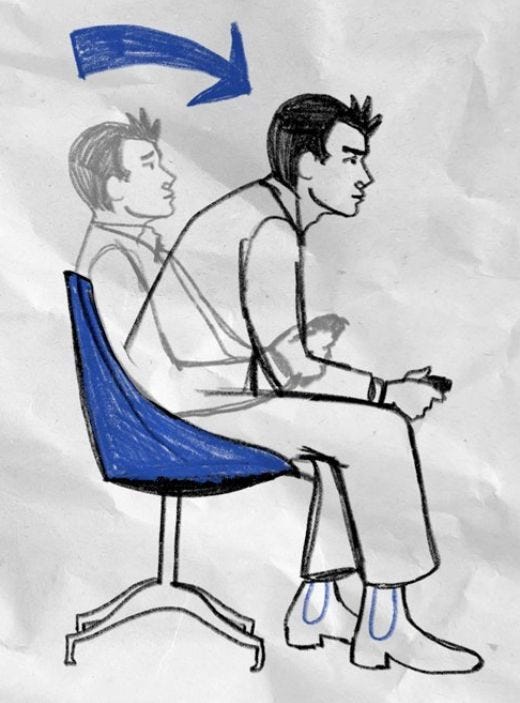
On the other hand, when you do well and succeed, you’re Locked-in. This is when you’re firing on all cylinders; you’re playing to the best of your abilities, and you can see the positive impact you’re making. In my opinion, this is where gaming is at its best. When you’re pushing your skills, and being rewarded for it.
I have a few personal examples for this, starting off with Ninja Gaiden II. It’s the first single-player game I mention here. It’s so tough, that it plays like a competitive game. You have to really try to make it through this game. Enemies are relentless, they outnumber you, and they want you dead. There’s nothing more offensive to them than your mere existence. You have to be mindful of every enemy on screen, take note of all the projectiles flying at you, know what buttons you’re pressing for each attack, basically be aware of everything. Once you play the game enough, It’ll seem less overwhelming and you can get through a lot of it relatively easily, but it’s still a game that demands you pay attention. If you get comfortable for a little bit, an enemy can sneak into your range and grab you, taking off half your health in the process.
Shmups fit here pretty neatly. One of the reasons why I like Blue Revolver is that I can feel myself locking in when I play. Hyper-focusing on a bullet pattern, and threading the needle through it feels great.
Sekiro is another I’d put here any time. It’s tough as nails, and it demands all your concentration, but it’s a lot of fun. I wouldn’t put the effort too high, since in terms of mechanics it’s more about rhythm and reactions, nothing that would break your fingies. It still puts me in the zone, where I focus on one thing, like parry timings. It’s always a cool feeling when you automatically react to something and dodge it even before your mind registers it, and you go “holy crap, I actually did that?”.
Speaking of rhythm, rhythm games certainly fit here. I don’t play many of them, but when I do, I lock-in. Heck, one of the first times I noticed that feeling of being fully immersed and “in the zone” was while playing Dance Dance Revolution as a kid. Nowadays I stick to rhythm on a controller, since I don’t want my downstairs neighbors to think I’m holding an unsanctioned horse race in my apartment, so I’ll put Miku here.
Running it down.

The exact opposite of engaged and thriving, is bored and dying. Running it down comes from MOBA terminology. When someone has had it with the game, they’ve given up completely, they “run it down mid”, which means they run down the mid lane and die over and over again as a form of protest. It could also mean “running it down” any lane, doesn’t have to be mid lane. It’s when you’re completely and irredeemably DONE with it. You’re not having fun, and you’re not really trying. You’re barely playing the game.
Since this comes from MOBAs, the generic example would be a game where you’ve died 20 times, you’re way behind the enemy team, and any and all efforts you make end in failure. Not like when you’re sweating. You’re not really even able to try here. Your plans don’t make it past the drawing board. You start drafting a strategy, and the enemy team breaks into your room, snaps your pencil and sets your notebook on fire, then they give you a wedgie.
A lot of people seem to have this experience in fighting games. They try something like Guilty Gear, or Blazblue, and they end up in a 20 second combo, or blocking for ever, only to get hit once and die. They can’t even move, or attack or do anything. They’re watching their opponent do a combo video with them as the training dummy.
I’ve played a lot of fighting games, and I managed to make it past the phase where I get beat like an old carpet, but there are two games that are sticking points: Marvel VS Capcom 3 and the aforementioned Blazblue. I always get stuck in some weird cross-up in MvsC3, or fall for some left-right mix up that happens in less than 0.001 seconds. While I’m still trying to figure out how to move my character, the enemy Magneto square jumps at me, covered by a Dante assist, gets me in a touch of death combo, then my incoming character gets crossed-up and I watch as I lose two thirds of my team to two mistakes. Same with Blazblue. Anytime I play that one I end up in a 30 second block string. This is purely a skill issue on my part, I admit that 100%. I’ve had “get better at MvsC3 and Blazblue” on my to-do list for years, but it’s not a priority.
A game that neatly combines low effort with low fun is Gungrave G.O.R.E. It’s one of the first games I reviewed here on Load Last Save, and it’s a miserable time. You mash the fire button mindlessly through stages that are too long for their own good. There’s no difficulty, no strategy, nothing that would make you want to stick around. Enemies are like grass, they exist to be mowed down, and offer no resistance. From the start to the end of the game, you’re mashing the fire button with no real concern as to what’s happening in the level. It’s a snooze fest. Read the review for more insight into this terrible game.
GGEZ

GG EZ is a victory lap. You’re not trying, but it’s not a bad thing. This is calm, relaxed fun. Playing a game you’re really good at, that you’ve beaten hundreds of times. It could also be playing a game purely for fun with your friends. Winding down with some friendslop like Peak. The videogame equivalent of slapping each other with pool noodles for a bit. In a competitive/versus setting, when not playing with friends, it could be stomping on some noobs. Maybe you pick a character you’re not familiar with, and you mess around, beating people, or using dumb ineffective gimmick strategies. Going off-meta in games is usually this; enjoyable, as long as you can ignore your team’s wailing.
A game that comes to mind for this one is Balatro. I always think of this one as Slay the Spire’s more relaxed cousin. It’s not as intense, but that’s not necessarily a bad thing. I think its mechanics are still solid, and there’s some thinking involved, but it’s not the min-maxed turbo efficiency you need to clear a run of Slay the Spire. Pick the funny Jokers, play pairs and watch the numbers go up and make dopamine-inducing noise.
Tower defense games go here. Some, like the bad ones I mentioned in my post about them, go in the miserable section, but the good ones like Bloons 2 and Kingdom Rush are good, easy fun. Some of the later stages get kind of difficult, but it’s still low-stakes enough to not go too far up the graph, while staying entertaining. Plus you get to watch the towers kill the little monsters (or balloons) and that’s soothing in its own way.
Playing a secondary character or going into unranked matches in some fighting games is GGEZ. Sometimes, when I play Street Fighter 6, I go into unranked, pick E. Honda, and spam headbutt like an idiot. Try to frustrate anyone who can’t deal with it. It’s mean, but it’s fun in its own right. Same with picking a supposed low tier character like Zangief or General Raam in Killer Instinct, and grabbing people for insane amounts of damage. True glue-eater behavior. It’s dumb, and it won’t help me improve, but it’s fun.
Conclusion
I recommend playing videogames. then quantifying your experience using an unscientific vibes-based chart. It goes without saying you should stick to the quadrant you’re most comfortable with, which is probably the two on the right, and avoid anything on the left. Unless you like feeling miserable, for some reason. Maybe you really love emo.
All this is purely subjective. A game I put in lock-in could easily be someone else’s “running it down”. The same game can fit into multiple categories, depending on how you play it and why. I can play fighting games in a serious state of mind to lock-in, or I can go mash buttons and play like a chimp for a few cheap laughs.
I think games should cover both the high and low effort sides of the fun chart, but there’s also something to be said about games that can cover multiple sections. Deadlock, and the other one I said I wouldn’t mention anymore, are both incredibly deep, complex games, with a lot of room for you to grow and improve, but that also means there are moments where you’ll fail and have absolutely horrific matches. I take it as a testament to their wide range of skill expression, but then again that could just be another cop-out.
Another cop-out is that, if you play competitive games, you won’t be able to completely avoid the left side of the graph. It comes with the territory. The thing to do is to try to learn from the misery, and make the most of it. Enjoy the process. Just try to avoid the “running it down” quadrant at all costs. There’s nothing to gain there. If you’re really not having fun, you can go play something else. It’s just a game. I don’t advocate ragequitting or leaving mid-match, but maybe consider not queuing up again. Play some Blue Revolver instead.
Have fun putting games in the quadrants and sharing it with your friends. If someone already did this, let me know. The chart, I mean. I’ve seen similar charts, but not one exactly like this.