

Thoughts (and prayers) about Dead or Alive 7
A big handful of reasons why I'm skeptical (and hopeful)

I play it for the plot
Dead or Alive? Good question. I’d say dead. At least it has been since the release of Dead or Alive 6. Now it’s going to be brought back to life with the release of… Dead or Alive 6 again? Is this like in math, where you multiply two negatives and get a positive? If that fails, we still have the upcoming seventh installment in the series to look forward to. For a while, at least.
Today I’ll be talking about Dead or Alive for a bit. Giving my opinions on the franchise, why DoA 6 failed and how this all relates to the fact that no one wants to play fighting games, and how Dead or Alive 7 needs to learn from 6’s many, many mistakes.
and, yeah, we’ll discuss the boobs, don’t worry.
Some Context
To really discuss Dead or Alive, we have to go a little further back, for context. You see, back in 1822, a man by the name of Charles Babbage invented a device we now call a computer. Then SEGA used this computer to make Virtua Fighter a couple of years later. Tomonobu Itagaki played Virtua Fighter and dared to ask “what if Virtua Fighter, but boobs?”, so he made Dead or Alive.
The franchise kept going for several installments. Each of them had fun, polished gameplay with deep mechanics. It was easy to learn, hard to master, much like its predecessor Virtua Fighter. You had three attack buttons, 3D movement and the hold system, which was a kind of parry/counter feature that made defense something the player actively participated in. The games were genuinely well crafted, top-tier arcade experiences.
Along with the gameplay, the series was pioneering graphics. Smooth polygons, motion captured animations and beautiful stages… and bazoogas.
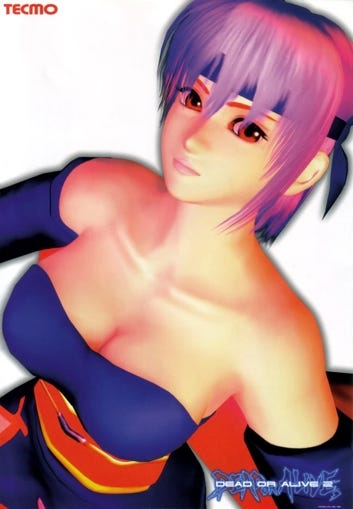
From Dead or Alive 2 onwards, the franchise focused a lot more on its female characters. The first game featured them prominently, but it also gave the guys some of the spotlight. Afterwards, they were there for legacy’s sake, and all eyes were on Kasumi and the others. Made sense, honestly. They were popular. So popular that they got their own spin-off, Dead Or Alive Xtreme Beach Volleyball, where they’d parade around in swimsuits. It even had a cringey commercial with a bunch of guys about to start a group goon sesh.
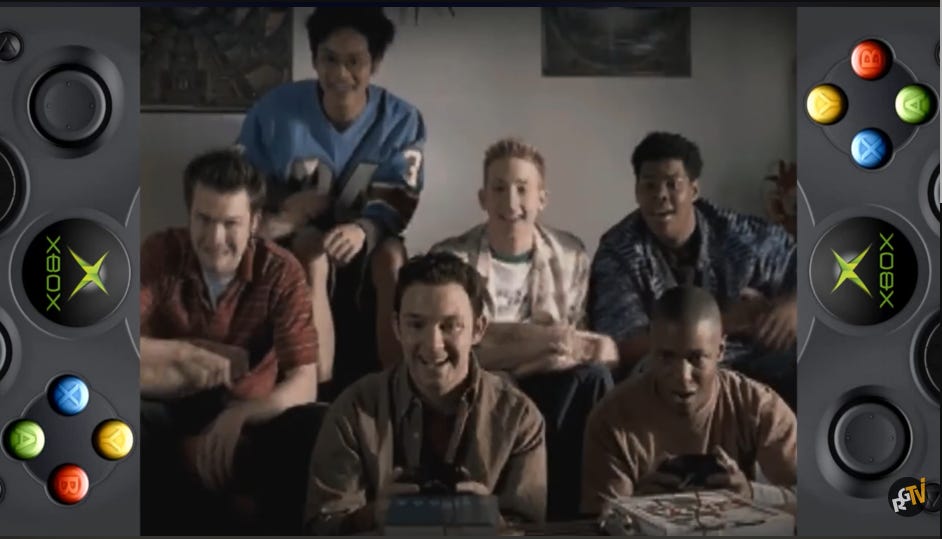
This shift in attention and aggressively-breasted marketing re-branded Dead or Alive from the fighting game with the girls, to the girls with that fighting mini-game. Public perception split. People who never played the games claimed the series was just softcore porn for horny losers. Since they were not horny losers, they didn’t play the games. Another vocal group, who also never played the games, said the games were fun, but they were put off by their overt sexuality. The people who actually played them were too busy- you know, actually playing the games- to give their opinion. They voted with their wallet, and the franchise kept going strong.
Then, for some reason- probably because Tomonobu Itagaki had left the company- the developers decided they needed to make a new Dead or Alive game that would be taken seriously. By whom? By the aforementioned people who never played the games in the first place.
How do you make Dead or Alive more serious? By aligning the series to the new Core Values.
Core Values
Dead or Alive 6 was going to be a REAL fighting game. Not like the previous games in the franchise. This one was going to focus on competitive play. It’s E-sports time, and that means they needed to appeal to advertisers. Get those titties out of here! Everyone knows there’s nothing advertisers hate more than using sex to sell products. Dead or Alive was now E-Sports. If you didn’t like it, you were just a dumb gooner who wanted to see 3D titties. Go watch porn instead, sicko!
Everything was lined up for Dead or Alive’s big comeback. Kasumi wasn’t in her iconic dress, she was in a full-body ninja suit. Not a sexy catsuit, you perv, a tactical suit that covered her up completely. The men took center stage, being shown throughout most of the trailer, and the game emphasized its brutal, realistic fighting. It was Dead or Alive for REAL gamers.
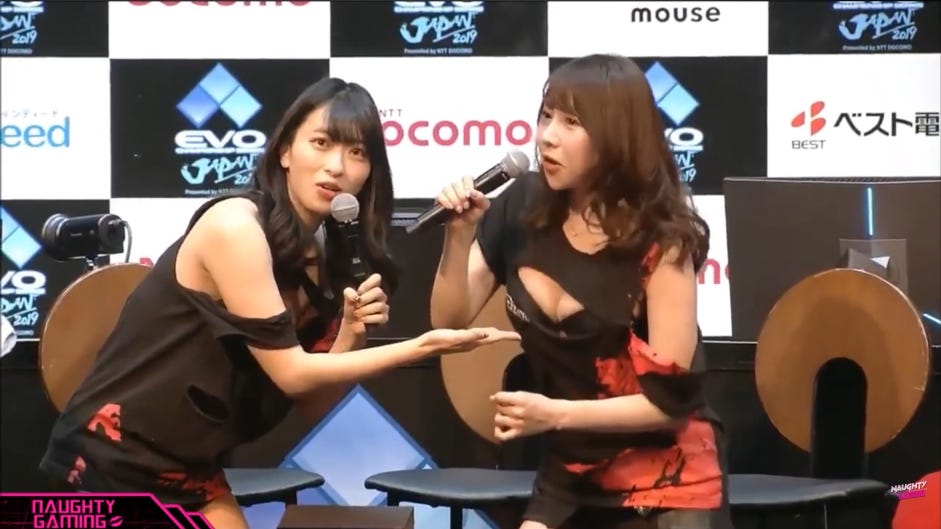
During a livestream for the game during Evo Japan 2019, the two presenters Saki Yoshida and Yuka Kuramochi (two swimsuit models) gave a live demonstration of the game’s jiggle physics. The suits didn’t like that. The livestream was interrupted, and the two were presumably given a stern talking to.
This incident was so horrific, that Joey Cuellar, the then-president of Evo, issued a tweet saying that what happened didn’t align with Evo’s Core Values.
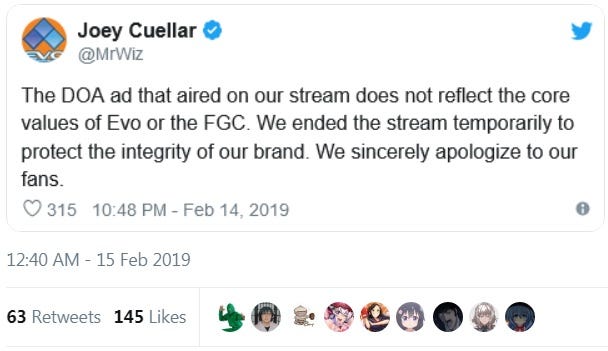
One year later, Cuellar was removed from Evo following accusations of sexual misconduct with minors. This is one of the few cases where even I think making a joke here would be in poor taste.
The situation soured Dead or Alive 6’s reputation, the incident became a big joke, and Dead or Alive 6 never appeared as a main-stage game at Evo. The game sold poorly. Its confused marketing put off its already dwindling fan base and failed to attract the people who would never play the game in the first place.
Ironically, the game that built its reputation on bouncy girls was destroyed by bouncy girls.
The game would flounder for a bit, then go free-to-play, which led to a few downloads. Support for the game stopped shortly after release, leaving almost no DLC for fans to buy, unlike the previous Dead or Alive game, which has over $1,000 worth of DLC on Steam. Dead or Alive 6 has sold over 900,000 copies as of writing this. That may sound like a lot, until you compare it to another Team Ninja game. Nioh 2, which released around the same time, had sold over 2 million copies in one year.
Now you might be thinking “Of course Nioh 2 sold more than Dead or Alive. DoA is a niche series”
Dead or Alive (and fighting games) are niche
There has been a lot of discussion on the viability of fighting games as products. There’s a long article floating around titled “Fighting Games Have a Product Design Problem”. As the title suggests, it’s about how fighting games fail to provide a decent overall experience when compared to other types of games. It’s well written and worth a look, but I’m not going to dissect it here. It has a lot of suggestions, mostly good, on how to make fighting games more complete and more appealing to newer players.
This article has a lot to do with 2XKO’s apparent flop. 2XKO, by the way, is the League of Legends fighting game. I wouldn’t blame you for not knowing that because 2XKO is a terrible name that doesn’t remind anyone of what it is. The game released, but no one really seems to care about it, and Riot laid off most of the team working on 2XKO. There’s a lot of speculation as to why, and I don’t know anything, so I won’t comment, but things look gray.
The problem the article, and many others, point to is that fighting games need to change to appeal to more players, so they don’t flop. I appreciate the passion, and I understand wanting fighting games to succeed, but I respectfully disagree.
I don’t think fighting games need to appeal to non-fighting game players. They don’t like the games. If you change your game, you’ll just alienate your audience chasing after potential buyers. Sure, you can get a hit here and there, but you have to remember that fighting games is a niche genre, and that’s okay. You just need to make a decent game with good features, at a reasonable budget, and sell it to the diehards.
Dead or Alive 7 won’t sell like Nioh, but it’s not supposed to. Developers should be fine with that, but they’re not. Fighting games were made in the arcade, and they sustained themselves on that business model. They thrived in that space. Some of the greatest fighting games ever came from the arcade, stuff like Guilty Gear, Darkstalkers, Street Fighter 3: Third Strike, Samurai Shodown and of course, Dead or Alive. They made their game, sold the cabinets and made their money back.
Now that developers hit the lottery with some mainstream success, they can’t go back. They had a taste of the multi-million sales figures, the season passes, the DLC, the giant prize pools at Evo.
Don’t try to chase an audience that doesn’t play Dead or Alive, don’t try to go for Evo or e-sports. Just make a game with cute girls, nice graphics and the classic hold>strike>throw triangle.
Fighting games are like classical music. Everyone likes to pretend they like them, but no one actually does.
The Discourse
Now that you have all the context and my thoughts on the whole thing, I’ll use my powers of clairvoyance to discuss the talking points that will enter The Discourse in the near future. That’s right, it’s opinion slop on events that haven’t even happened yet!
“I don’t play Dead or Alive because it’s gross, it’s just tits”
It’s more than just tits, but you wouldn’t know. You don’t play the games, and you were never going to.
“I like Dead or Alive, I just don’t play it because of the tits”
You don’t like the game, you like to tell others you do. If you did, you’d be playing it.
“Dead or Alive doesn’t appeal to me, because of the tits”
Perfectly understandable. It’s not for everyone, and if I have a right to like it because of that, then you have a right to dislike it for that reason.
Another point I can see coming up, which I have only hinted at, is the game’s monetization. I mentioned earlier that Dead or Alive 5 has over $1,000 worth of DLC. 99% of it is cosmetic. Glorified dress-up. The excuse here is that they need the DLC to keep the game running. Sure, I understand. Servers cost money, and nowadays you can’t make a game and sell it, you need to make it last forever with endless updates. The thing is, knowing Koei Tecmo, they’re going to sell the game for $70, and charge for seasonal DLC and cosmetics on top of that. Sure, you can opt out of the cosmetics. They don’t affect gameplay, but the DLC will. Like every other fighting game, they’ll release characters over time, and you’ll have to pay up despite having spent $70 for the base game. It’s standard practice in the industry, but I hate it.
We’ve seen how bad it can get with Dead or Alive 6, and how it charged players a dollar to change a character’s hair color.
It’s also pretty bad when you go to a game’s Steam Page and see hundreds of dollars of DLC waiting there. You know the game’s going to do its best to crowbar your wallet out of your pocket.

Netcode is another sticking point. DoA 6 uses delay-based netcode, which sucks. Rollback should be the standard by now. It should have been the standard when GGPO made it easy to implement rollback into anything, and that’s been working well since at least 2011. The updated version, Dead or Alive 6: Last Round hasn’t been confirmed to have rollback. It probably still uses the old, outdated delay-based netcode.
Cross-play is extremely important, too. DoA 6 doesn’t have it, and the Last Round update won’t, either. Seven needs to have crossplay. Like rollback netcode, this should be standard by now. Not offering this would be leaving money on the table. Guilty Gear Strive, Street Fighter 6, Virtua Fighter 5 REVO and City of the Wolves all have crossplay. They also use rollback.
Include those quality of life features, and I’m in on day one.
I’m still skeptical. DoA6: Last Round is coming out soon. Same game, no improvements on the netcode, no crossplay and they’re removing Kula and Mai. It’s Dead or Alive 6, with less content. I saw some apes on Reddit saying how this wasn’t a big deal, but it is. It’s a big deal. Why would I pay $40 for the same game, with less characters and no improvements?
I’m going to huff an entire tank of copium and say it’s because DoA6 is already made, and there’s no way of changing it. I know that’s bullshit, but again, I’m on copium. Maybe they learn from this and fix it in 7. Maybe.
Conclusion
I want Dead or Alive 7 to be an unironic “Return to Form” for the series. It should be a lighthearted game with surprisingly deep mechanics that can only be enjoyed by the people who actually play it, and not the kind of puritanical weirdo that calls things like Marvel Rivals a gooner game. They’re not going to buy the game. Stop appealing to them. The only thing they should be buying is soap.
If the game is another attempt at being a serious fighting game for big boys, it’s going to fail. Dead or Alive 6 tried that. It didn’t work. Forget trying to appeal to the EFF GEE SEA’s core values. The only core Dead or Alive should focus on is the softcore.
Fighting games are a niche thing, and Dead or Alive is a niche within a niche. Give the fans what they want, and you’ll be rewarded. Don’t go chasing waterfalls, or a potential audience that might buy millions of copies of your game, if they somehow decide to like it now.
As long as the game plays like the previous games, has rollback netcode and crossplay, it’s an easy buy for most people, myself included. And, yeah, keep the boobs in.
People often rightly point out that things that seem like simple solutions to obvious problems are not so easily implemented when you're talking about the reality of a game that's had tens of thousands of work hours already poured into it, tangled interdependencies of code, and so on, and of course there's no guarantee that a game being well designed and made will necessarily be a success... but it still seems like so many of these flops/bombs/franchise killers are totally self-inflicted. How many meetings do you think people involved in development attended where rollback netcode was mentioned? Now how many do you think there were where the amount of skin shown was debated?